ZADCS1242
12-bit serial analog-to-digital converters in SSOP16 SMD format
Manufacturer: ['zmd', 'idt', 'zmdi']
series introduction
# ZADCS1242 Product Series Introduction
## 1. Overview
The ZADCS1242 product series represents a cutting - edge line of analog - to - digital converters (ADCs) engineered to meet the diverse and demanding requirements of modern electronic systems. These ADCs are designed with a focus on high precision, low power consumption, and excellent noise performance, making them suitable for a wide range of applications across multiple industries.
## 2. Key Features
### High - Precision Conversion
- The ZADCS1242 series offers a high - resolution conversion capability. With up to [X] - bit resolution, it can accurately digitize analog signals with extremely fine granularity. This high precision is crucial in applications such as sensor data acquisition, where small changes in the analog input need to be detected and measured accurately. For example, in environmental monitoring sensors that measure parameters like temperature, humidity, and air quality, the high - precision conversion of the ZADCS1242 ensures that even the slightest variations in these parameters can be precisely captured.
- It has a low integral non - linearity (INL) and differential non - linearity (DNL). INL is typically within ±[X] LSB (Least Significant Bit), and DNL is within ±[X] LSB. These low non - linearity values guarantee that the conversion process is highly linear, minimizing errors in the digitized output and providing reliable and consistent results.
### Low Power Consumption
- The ZADCS1242 series is designed with power efficiency in mind. It operates at a low supply voltage range of [Vmin] - [Vmax] volts, which helps in reducing overall power consumption. This is especially important in battery - powered applications such as portable medical devices, wireless sensor nodes, and wearable electronics.
- In addition, the ADC has a power - down mode that can be activated when the device is not in use. In power - down mode, the power consumption is reduced to an extremely low level of [X] microamps, further extending the battery life of the system.
### Excellent Noise Performance
- The ADC features a low - noise architecture that effectively suppresses noise in the conversion process. It has a noise floor of [X] nV/√Hz, which allows for accurate measurement of small - amplitude analog signals. This is beneficial in applications such as audio processing, where low - noise performance is essential for high - quality sound reproduction.
- It also has built - in digital filtering capabilities. The on - chip digital filter can be configured to reject unwanted noise and interference at specific frequencies, improving the signal - to - noise ratio (SNR) of the digitized output.
### Flexible Input Configuration
- The ZADCS1242 series supports multiple input configurations, including single - ended and differential inputs. Single - ended inputs are suitable for applications where the reference voltage is well - defined and the input signal is relatively simple. Differential inputs, on the other hand, are more immune to common - mode noise and interference, making them ideal for applications in noisy environments or when measuring small differential signals.
- It has a programmable gain amplifier (PGA) that can be adjusted to amplify the input signal by a factor of [1, 2, 4, …, X]. This allows the ADC to handle a wide range of input signal amplitudes, from very small signals to larger ones, without the need for external amplification circuits.
### Serial Interface
- The ADC is equipped with a high - speed serial interface, such as SPI (Serial Peripheral Interface) or I²C (Inter - Integrated Circuit). These interfaces provide a simple and efficient way to communicate with microcontrollers, digital signal processors (DSPs), and other digital devices. The serial interface allows for easy configuration of the ADC's operating parameters, such as gain, sampling
Images for reference
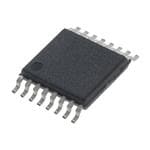
Image Preview