TMS320LF2406APZA
16-bit fixed-point digital signal processors with 64KB flash memory
Manufacturer: ['rochester', 'ti']
series introduction
# Introduction to the TMS320LF2406APZA Product Series
## 1. Overview
The TMS320LF2406APZA belongs to the TMS320LF240x family of digital signal processors (DSPs) developed by Texas Instruments. These DSPs are specifically designed for embedded control applications, offering a powerful combination of high - performance signal processing capabilities and efficient control functions. The "TMS320" is the general prefix for Texas Instruments' DSP product line, "LF" indicates low - power operation, "2406" is the specific model number within the 240x series, and "APZA" represents a particular package and speed grade.
## 2. Key Features
### 2.1 Core Processing Power
- **High - Speed CPU**: The TMS320LF2406APZA is based on a 16 - bit fixed - point DSP core. It can execute instructions at a clock speed of up to 40 million instructions per second (MIPS). This high processing speed enables it to handle complex algorithms and real - time control tasks efficiently.
- **Harvard Architecture**: It utilizes a modified Harvard architecture, which features separate program and data memory buses. This allows for simultaneous access to program instructions and data, significantly enhancing the processing throughput.
### 2.2 Memory Configuration
- **On - Chip Memory**:
- **Flash Memory**: It comes with 32K words of on - chip flash memory. Flash memory is non - volatile, which means the program code can be stored even when the power is turned off. This is extremely useful for embedded applications where the system needs to retain its functionality across power cycles.
- **Data Memory**: There is 2.5K words of on - chip data memory (RAM). This memory is used for storing variables, intermediate results, and other data during program execution.
- **External Memory Interface**: The device also provides an external memory interface, which allows for the expansion of memory if the on - chip memory is insufficient. It can interface with external RAM, ROM, or other memory devices, providing flexibility for different application requirements.
### 2.3 Peripheral Interfaces
#### 2.3.1 Serial Communication
- **Serial Peripheral Interface (SPI)**: The SPI interface enables high - speed serial communication between the TMS320LF2406APZA and other SPI - compatible devices such as sensors, actuators, or other microcontrollers. It supports full - duplex communication and can operate at different clock speeds, making it suitable for a wide range of applications.
- **Universal Asynchronous Receiver/Transmitter (UART)**: The UART interface provides asynchronous serial communication, which is commonly used for communication with devices such as personal computers, modems, or other serial - enabled devices. It supports standard baud rates and can be configured for different data formats.
#### 2.3.2 Analog - to - Digital Conversion
- **Analog - to - Digital Converter (ADC)**: The TMS320LF2406APZA is equipped with a 10 - bit ADC. It has up to 16 input channels, allowing it to sample multiple analog signals simultaneously. The ADC can be used for applications such as sensor data acquisition, where analog signals from sensors need to be converted into digital values for further processing.
#### 2.3.3 Pulse - Width Modulation (PWM)
- **PWM Modules**: It features multiple PWM modules, which are essential for motor control applications. The PWM signals can be used to control the speed, torque, and direction of motors. The PWM modules offer features such as programmable duty cycles, frequencies, and dead - band insertion, providing precise control over the motor
Images for reference

100-LQFP
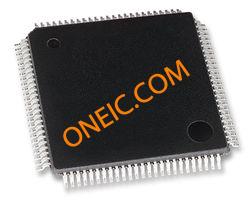
Image Preview

Image Preview