TMS320F240PQA
16-bit microcontrollers and DSPs in 132-pin BQFP packages
Manufacturer: ['rochester', 'analog-devices', 'ti']
series introduction
# Introduction to the TMS320F240PQA Product Series
## 1. Overview
The TMS320F240PQA belongs to the TMS320F24x family of digital signal processors (DSPs) developed by Texas Instruments. These DSPs are specifically designed to meet the demanding requirements of embedded control applications, offering a unique combination of high - performance signal processing capabilities and efficient control functions.
## 2. Key Features
### 2.1 High - Performance CPU
- **Harvard Architecture**: The TMS320F240PQA utilizes a modified Harvard architecture, which allows for simultaneous access to program and data memory. This architecture significantly enhances the processing speed by enabling concurrent instruction fetch and data access operations.
- **Fast Execution Speed**: With a clock speed of up to 20 MHz, the DSP can execute instructions in a single cycle for many operations. This high - speed execution is crucial for real - time control applications where quick response times are required.
### 2.2 Memory Configuration
- **On - Chip Memory**:
- **Program Memory**: It comes with 32K words of flash memory, which can be used to store the application program. Flash memory provides non - volatile storage, allowing the program to be retained even when the power is turned off. This is beneficial for applications where the program needs to be stored permanently without the need for external storage devices.
- **Data Memory**: There is 2.5K words of on - chip random - access memory (RAM). This RAM is used for storing variables, intermediate results, and data buffers during program execution.
- **External Memory Interface**: The DSP also features an external memory interface, which allows for the expansion of both program and data memory. This is useful when the on - chip memory is insufficient for larger applications.
### 2.3 Peripheral Modules
#### 2.3.1 Timer Modules
- **Multiple Timers**: The TMS320F240PQA is equipped with three 16 - bit general - purpose timers. These timers can be used for a variety of functions such as generating time delays, measuring time intervals, and implementing PWM (Pulse Width Modulation) signals.
- **PWM Generation**: The timers are capable of generating high - resolution PWM signals, which are essential for motor control applications. The PWM signals can be used to control the speed and torque of motors by adjusting the duty cycle.
#### 2.3.2 Analog - to - Digital Converter (ADC)
- **10 - Bit Resolution**: The on - chip ADC has a 10 - bit resolution, which provides sufficient accuracy for most control applications. It can convert analog input signals into digital values, allowing the DSP to process real - world analog signals such as voltage, current, and temperature.
- **Multiple Input Channels**: The ADC has up to 16 input channels, enabling the simultaneous sampling of multiple analog signals. This is useful for applications that require monitoring multiple physical parameters.
#### 2.3.3 Serial Communication Interfaces
- **Serial Peripheral Interface (SPI)**: The SPI interface allows for high - speed serial communication between the DSP and other devices such as sensors, actuators, or other microcontrollers. It supports full - duplex communication and can operate at high clock speeds.
- **Universal Asynchronous Receiver/Transmitter (UART)**: The UART interface provides a standard asynchronous serial communication method, which is commonly used for communication with computers, modems, or other serial devices. It is suitable for long - distance communication and is widely used in industrial control systems.
### 2.4 Instruction Set
- **Rich Instruction Set**: The TMS320F240PQA has a rich instruction set that includes arithmetic
Images for reference
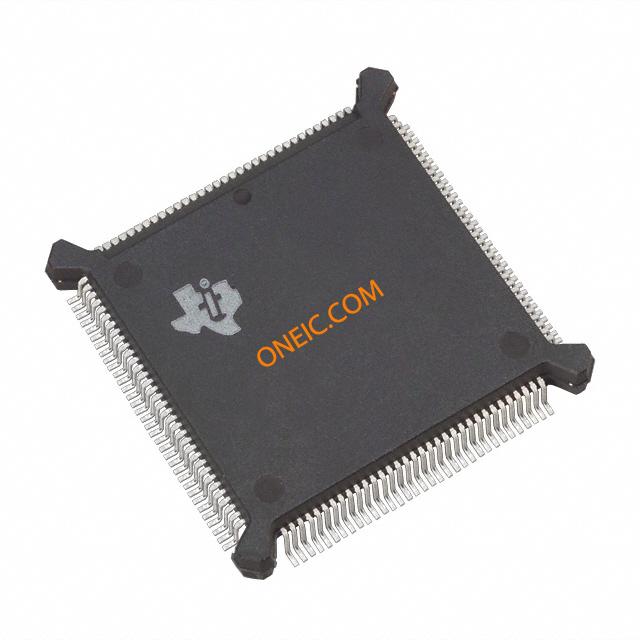
132-BQFP
Image Preview