TMS320C6201GJC200
High-performance fixed-point digital signal processors for advanced computing
Manufacturer: ti
series introduction
# Introduction to the TMS320C6201GJC200 Product Series
## 1. Overview
The TMS320C6201GJC200 belongs to Texas Instruments' TMS320C6000 series of digital signal processors (DSPs). This product series is renowned for its high - performance processing capabilities, making it a popular choice in a wide range of applications that demand real - time signal processing.
## 2. Key Features
### 2.1 Processing Power
- **High - Speed CPU**: The TMS320C6201GJC200 is clocked at 200 MHz. This high clock speed enables it to execute a large number of instructions per second, allowing for rapid data processing. It uses a very long instruction word (VLIW) architecture, which can issue multiple instructions simultaneously in a single clock cycle. This parallel processing ability significantly enhances the overall computational throughput, making it suitable for complex algorithms such as those used in image and video processing, and telecommunications.
- **Floating - Point and Fixed - Point Operations**: It supports both fixed - point and floating - point arithmetic operations. Fixed - point operations are useful for applications where power consumption and cost are major concerns, as they generally require less hardware resources. Floating - point operations, on the other hand, are essential for applications that demand high precision, such as scientific simulations and advanced signal processing algorithms.
### 2.2 Memory Architecture
- **On - Chip Memory**: The device is equipped with a significant amount of on - chip memory. This includes a large amount of data memory and program memory. The on - chip memory reduces the need for external memory access, which in turn speeds up the processing time. It also helps in reducing power consumption as accessing on - chip memory is more energy - efficient than accessing external memory.
- **Memory Management Unit (MMU)**: The MMU in the TMS320C6201GJC200 provides a flexible memory management scheme. It allows for the efficient mapping of virtual addresses to physical addresses, enabling the use of large amounts of external memory if required. This is particularly useful in applications where a large dataset needs to be processed.
### 2.3 Peripherals
- **Multiple Communication Interfaces**: It features a variety of communication interfaces, such as serial ports, parallel ports, and external memory interfaces. The serial ports can be used for communication with other devices, such as sensors or other microcontrollers. The parallel ports are useful for high - speed data transfer between the DSP and external devices. The external memory interface allows for the connection of external memory modules, such as SDRAM or Flash memory, to expand the available memory space.
- **DMA Controller**: The Direct Memory Access (DMA) controller in the TMS320C6201GJC200 enables the transfer of data between different memory locations without the intervention of the CPU. This frees up the CPU to perform other computational tasks, thereby improving the overall system efficiency.
## 3. Applications
### 3.1 Telecommunications
- **Base Station Signal Processing**: In cellular base stations, the TMS320C6201GJC200 can be used for tasks such as channel coding, modulation, and demodulation. Its high - speed processing capabilities allow for the real - time handling of multiple communication channels, ensuring reliable and efficient communication between the base station and mobile devices.
- **Voice over IP (VoIP) Systems**: For VoIP applications, the DSP can perform tasks such as voice compression, echo cancellation, and packetization. These functions are crucial for providing high - quality voice communication over IP networks.
### 3.2 Image and Video Processing
- **Surveillance Systems**:
Images for reference
.jpg)
352-FCBGA
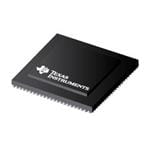
Image Preview