TMS320C50PQA57
Digital signal processors and controllers for advanced signal processing
Manufacturer: ti
series introduction
# Introduction to the TMS320C50PQA57 Product Series
## 1. Overview
The TMS320C50PQA57 belongs to Texas Instruments' TMS320C50 series of digital signal processors (DSPs). These DSPs are designed to offer high - performance signal processing capabilities for a wide range of applications. The TMS320C50PQA57 is specifically engineered to handle complex algorithms and real - time signal processing tasks with efficiency and reliability.
## 2. Key Features
### 2.1 Processing Power
- **High - Speed CPU**: The TMS320C50PQA57 is equipped with a powerful central processing unit (CPU) that can execute instructions at a high clock speed. This enables it to perform a large number of operations per second, making it suitable for applications that require real - time processing, such as audio and video processing, telecommunications, and industrial control.
- **Advanced Instruction Set**: It features an optimized instruction set that includes a variety of arithmetic, logical, and data - transfer instructions. These instructions are designed to accelerate common signal processing algorithms, such as filtering, Fourier transforms, and correlation.
### 2.2 Memory Architecture
- **On - Chip Memory**: The device has a significant amount of on - chip memory, including both program memory and data memory. This on - chip memory reduces the need for external memory access, which in turn improves the processing speed and reduces power consumption.
- **Memory Management Unit (MMU)**: The MMU in the TMS320C50PQA57 allows for efficient memory management. It enables the processor to access different memory regions with different access rights, which is crucial for protecting critical data and ensuring system stability.
### 2.3 Peripherals
- **Communication Interfaces**: It comes with a variety of communication interfaces, such as serial ports (UART), serial peripheral interface (SPI), and inter - integrated circuit (I2C). These interfaces allow the TMS320C50PQA57 to communicate with other devices, such as sensors, actuators, and external memory modules.
- **Analog - to - Digital Converters (ADCs) and Digital - to - Analog Converters (DACs)**: The inclusion of ADCs and DACs on the chip enables the direct interface with analog signals. This is particularly useful in applications such as audio processing, where analog signals need to be converted to digital form for processing and vice versa.
### 2.4 Power Management
- **Low - Power Modes**: The TMS320C50PQA57 is designed with multiple low - power modes. These modes can be used to reduce power consumption when the processor is not actively performing tasks, making it suitable for battery - powered applications.
- **Dynamic Voltage and Frequency Scaling (DVFS)**: DVFS technology allows the processor to adjust its voltage and frequency according to the workload. This further optimizes power consumption while maintaining the required performance level.
## 3. Applications
### 3.1 Audio Processing
- **Audio Effects**: The high - speed processing capabilities of the TMS320C50PQA57 make it ideal for implementing audio effects, such as reverb, delay, and equalization. It can process audio signals in real - time, providing high - quality sound output.
- **Audio Codecs**: It can be used in audio codec applications, where it encodes and decodes audio signals. The on - chip ADCs and DACs simplify the design of audio codec systems.
### 3.2 Telecommunications
- **Modulation and Demodulation**: In telecommunications systems, the TMS320C50PQA57 can
Images for reference
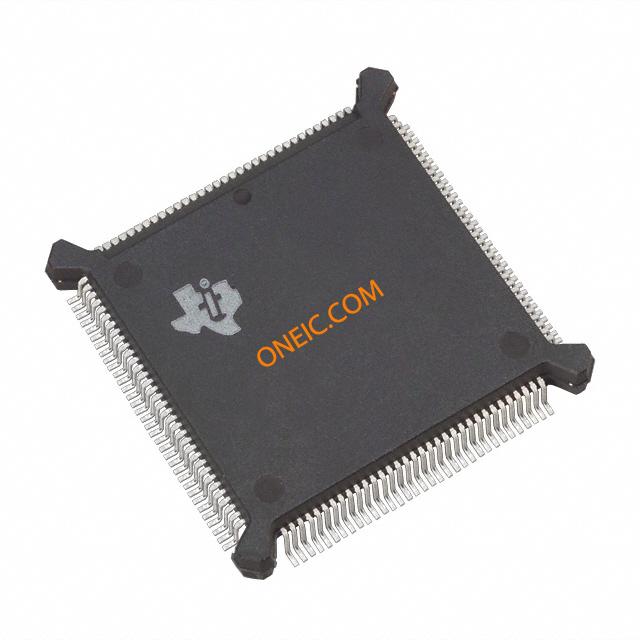
132-BQFP