STM8L152C6T6
8-bit ultralow power microcontrollers with 32KB flash and 48-pin LQFP
Manufacturer: stm
series introduction
# Introduction to the STM8L152C6T6 Product Series
## 1. Overview
The STM8L152C6T6 is a member of STMicroelectronics' STM8L series of ultra-low-power 8-bit microcontrollers. These microcontrollers are designed to offer a high - performance and energy - efficient solution for a wide range of applications, from battery - powered devices to industrial control systems.
## 2. Key Features
### 2.1 Core and Architecture
- **8 - bit Core**: Based on the STM8 core, which provides a simple yet powerful instruction set. It offers a good balance between performance and code density, allowing developers to write efficient programs with relatively small memory footprints.
- **Harvard Architecture**: The use of a Harvard architecture separates the program memory and data memory buses. This enables simultaneous access to instructions and data, enhancing the overall processing speed and efficiency of the microcontroller.
### 2.2 Memory
- **Flash Memory**: The STM8L152C6T6 is equipped with 32 KB of in - system programmable Flash memory. This non - volatile memory is used to store the user's application code. It supports in - system programming (ISP) and in - application programming (IAP), which means that the code can be updated even after the microcontroller is installed on the target board.
- **RAM**: It has 4 KB of random - access memory (RAM). The RAM is used for storing variables, intermediate results, and stack operations during the execution of the program.
### 2.3 Low - Power Modes
- **Multiple Low - Power Modes**: One of the standout features of the STM8L152C6T6 is its ultra - low - power operation. It offers several low - power modes, including Halt, Wait, and Active - Halt modes.
- **Halt Mode**: In this mode, the CPU is stopped, and only the real - time clock (RTC) and some low - power peripherals can remain active. This mode consumes extremely low power, making it ideal for battery - powered applications where long battery life is crucial.
- **Wait Mode**: The CPU is stopped, but the clock to the peripherals can be maintained. This allows the microcontroller to quickly wake up in response to an external event while still saving power.
- **Active - Halt Mode**: In this mode, the CPU is stopped, but the voltage regulator remains in a low - power state, and some peripherals can be kept active. It provides a balance between power consumption and the ability to quickly resume normal operation.
### 2.4 Peripherals
- **Timers**: The microcontroller includes multiple timers, such as general - purpose timers and advanced - control timers. These timers can be used for a variety of applications, including pulse - width modulation (PWM) for motor control, generating accurate time delays, and measuring time intervals.
- **Analog - to - Digital Converter (ADC)**: It has a 10 - bit ADC with up to 16 channels. The ADC can be used to convert analog signals from sensors (such as temperature sensors, light sensors, etc.) into digital values that can be processed by the microcontroller.
- **Universal Synchronous/Asynchronous Receiver/Transmitter (USART)**: The USART allows the microcontroller to communicate with other devices using serial communication protocols. It supports both synchronous and asynchronous communication modes, making it suitable for a wide range of communication applications, such as connecting to other microcontrollers, sensors, or displays.
- **Inter - Integrated Circuit (I2C) Interface**: The I2C interface enables the microcontroller to communicate with other I2C - compatible devices, such as E
Images for reference
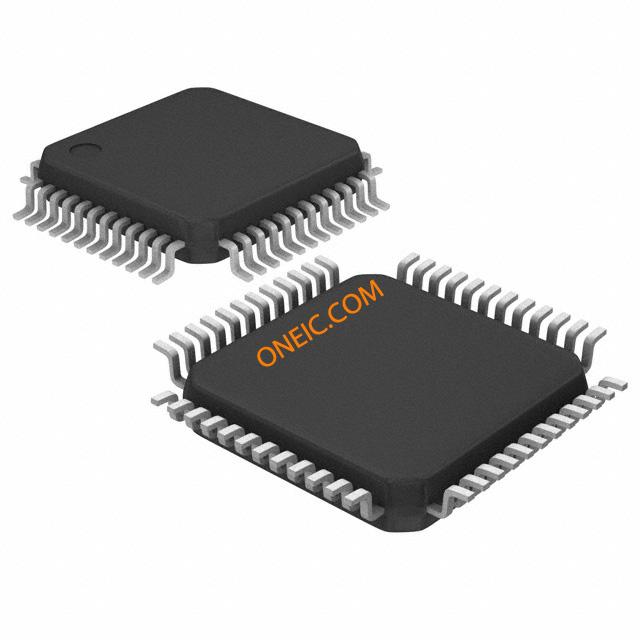
48-LQFP
Image Preview
Image Preview