STM32F217Z
32-bit ARM Cortex M3 microcontrollers with up to 1024KB flash memory
Manufacturer: stm
series introduction
# Introduction to the STM32F217Z Product Series
## 1. Overview
The STM32F217Z series is a high - performance line of microcontrollers developed by STMicroelectronics. These microcontrollers are based on the ARM Cortex - M33 core, which combines high processing power with low power consumption, making them suitable for a wide range of applications in various industries.
## 2. Key Features
### 2.1 Processing Power
- **High - speed Core**: The ARM Cortex - M33 core at the heart of the STM32F217Z series can operate at a maximum frequency of [X] MHz. This high clock speed enables the microcontroller to execute complex algorithms and handle multiple tasks simultaneously, providing fast and efficient processing for demanding applications.
- **Instruction Set**: It supports the ARMv8 - M architecture, which includes a rich set of instructions for integer and floating - point operations. This allows for seamless implementation of advanced mathematical functions, such as signal processing and control algorithms.
### 2.2 Memory
- **Flash Memory**: The STM32F217Z microcontrollers are equipped with a large amount of on - chip flash memory, typically ranging from [X] KB to [X] KB. This non - volatile memory is used to store the program code, allowing for the development of large and complex applications. The flash memory also supports in - system programming (ISP) and in - application programming (IAP), enabling easy software updates and customization.
- **SRAM**: There is also a significant amount of static random - access memory (SRAM), usually [X] KB to [X] KB. SRAM is used for storing data during program execution, providing fast access to variables and buffers, which is crucial for real - time applications.
### 2.3 Peripherals
#### 2.3.1 Communication Interfaces
- **USB**: The series features USB 2.0 Full - Speed and High - Speed interfaces, which can be used for various purposes such as data transfer, device communication, and power management. USB connectivity allows the microcontroller to communicate with other devices, such as computers, smartphones, and USB - enabled sensors.
- **Ethernet**: An integrated Ethernet MAC (Media Access Controller) is available, supporting 10/100 Mbps communication. This enables the microcontroller to be used in network - connected applications, such as industrial automation, home automation, and Internet of Things (IoT) devices.
- **CAN**: The Controller Area Network (CAN) interface is included, which is widely used in automotive and industrial applications for reliable communication between different nodes in a network. It supports both CAN 2.0A and CAN 2.0B protocols.
- **SPI, I2C, and UART**: These standard serial communication interfaces are also provided, allowing the microcontroller to communicate with a wide range of external devices, such as sensors, actuators, and displays.
#### 2.3.2 Timers and Counters
- Multiple general - purpose timers and advanced - control timers are available. These timers can be used for various functions, such as generating PWM (Pulse Width Modulation) signals for motor control, measuring time intervals, and generating accurate delays.
- The advanced - control timers can also be used for more complex applications, such as controlling brushless DC motors and servo motors.
#### 2.3.3 Analog - to - Digital Converters (ADCs) and Digital - to - Analog Converters (DACs)
- The STM32F217Z series includes high - resolution ADCs, typically with [X] - bit resolution. These ADCs can be used to convert analog signals from sensors, such as temperature sensors,
Images for reference

144-LQFP
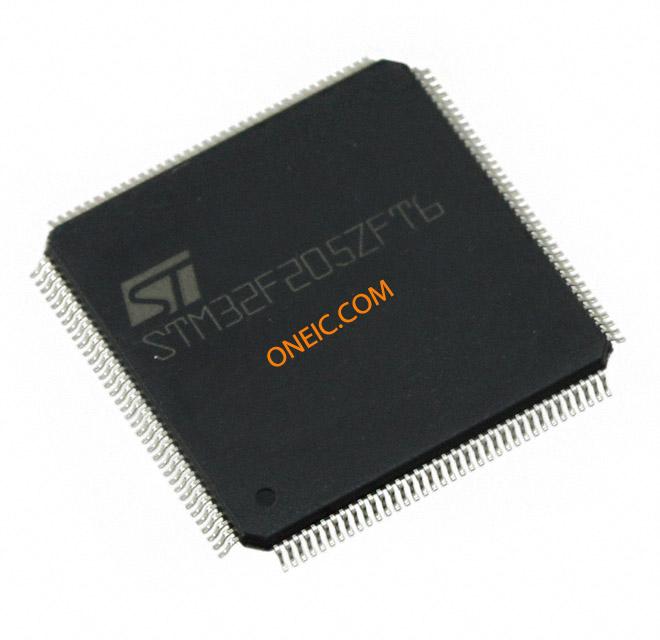
STM32-144LQFP
Image Preview