STM32F217IET6
32-bit ARM Cortex-M3 microcontrollers with 512KB flash memory
Manufacturer: stm
series introduction
# Introduction to the STM32F217IET6 Product Series
## 1. Overview
The STM32F217IET6 is a member of the highly popular STM32 microcontroller family developed by STMicroelectronics. This product series is designed to offer a powerful, flexible, and cost - effective solution for a wide range of embedded applications. With its advanced features and high - performance capabilities, it has become a preferred choice for engineers and developers in various industries.
## 2. Core and Architecture
### ARM Cortex - M3 Core
The STM32F217IET6 is based on the ARM Cortex - M3 32 - bit RISC core. This core provides a high level of performance with a maximum operating frequency of up to 120 MHz. The ARM Cortex - M3 architecture features a Harvard architecture with a 3 - stage pipeline, which enables efficient instruction execution and high - speed data processing. It also includes a nested vectored interrupt controller (NVIC) that can handle a large number of interrupt sources, allowing for real - time response to external events.
### Memory Organization
- **Flash Memory**: It comes with 1 MB of on - chip flash memory. This non - volatile memory is used to store the program code. The large flash memory capacity allows developers to implement complex algorithms and applications without the need for external memory expansion in many cases.
- **SRAM**: The microcontroller has 128 KB of static random - access memory (SRAM). SRAM is used for storing variables, data buffers, and the stack during program execution. The sufficient SRAM size ensures smooth operation of applications, especially those that require large data storage and manipulation.
## 3. Peripherals
### Communication Interfaces
- **USB**: The STM32F217IET6 is equipped with a full - speed USB 2.0 device/host/OTG controller. This allows the microcontroller to communicate with other USB - enabled devices, such as computers, smartphones, and USB peripherals. It simplifies the development of applications that require USB connectivity, such as data transfer, device control, and human - machine interface (HMI) applications.
- **Ethernet**: It features an Ethernet MAC (Media Access Controller) with a dedicated DMA (Direct Memory Access) controller. This enables the microcontroller to connect to local area networks (LANs) and communicate using the Ethernet protocol. Ethernet connectivity is useful for applications such as industrial automation, remote monitoring, and Internet of Things (IoT) devices.
- **UART, SPI, and I2C**: Multiple universal asynchronous receiver - transmitter (UART), serial peripheral interface (SPI), and inter - integrated circuit (I2C) interfaces are available. These interfaces are commonly used for communication with external sensors, actuators, and other microcontrollers. UART is suitable for long - distance serial communication, SPI offers high - speed data transfer, and I2C is used for connecting multiple devices on a single bus.
### Timers
- **General - Purpose Timers**: There are several general - purpose timers available, which can be used for a variety of tasks such as generating PWM (Pulse Width Modulation) signals, measuring time intervals, and counting external events. PWM signals are widely used in motor control, LED dimming, and power management applications.
- **Advanced - Control Timers**: The advanced - control timers provide additional features such as complementary PWM outputs with dead - time insertion, which is essential for applications like three - phase motor control.
### Analog - to - Digital Converters (ADCs)
The microcontroller includes multiple 12 - bit ADCs. These ADCs can be used to convert analog signals from sensors (such as temperature sensors, pressure sensors,
Images for reference
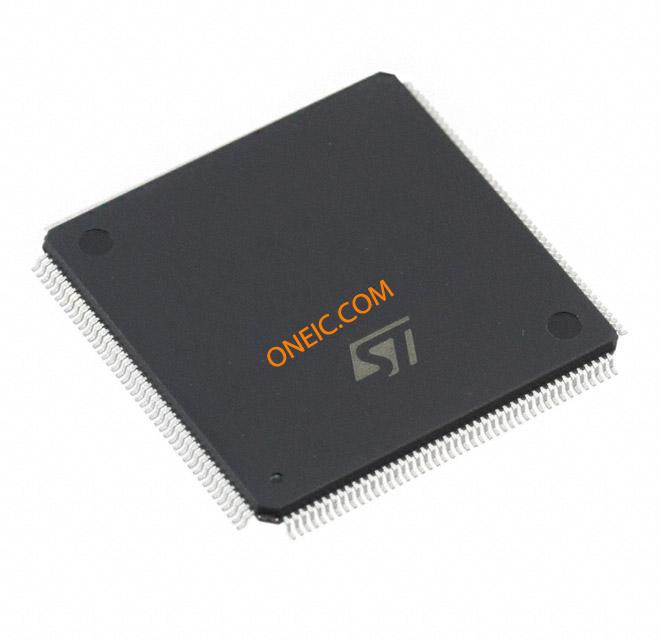
STM32-176LQFP

Image Preview
Image Preview