STM32F205ZGT6
32-bit ARM Cortex M3 microcontrollers with 1024KB flash memory, 144-pin LQFP package
Manufacturer: stm
series introduction
# Introduction to the STM32F205ZGT6 Product Series
## 1. Overview
The STM32F205ZGT6 is part of STMicroelectronics' STM32F2 series of 32 - bit microcontrollers based on the ARM Cortex - M3 core. These microcontrollers are designed to offer high - performance, low - power, and cost - effective solutions for a wide range of applications. The STM32F205ZGT6, in particular, stands out with its rich set of features and capabilities, making it suitable for complex embedded systems.
## 2. Core and Performance
### ARM Cortex - M3 Core
- The STM32F205ZGT6 is powered by the ARM Cortex - M3 32 - bit RISC core, which operates at a maximum frequency of 120 MHz. This high - speed core provides excellent processing power, enabling the microcontroller to handle complex algorithms and multitasking operations efficiently.
- The Cortex - M3 core features a Harvard architecture with separate instruction and data buses, allowing for simultaneous access to instructions and data. This results in faster execution times and improved overall performance.
- It also includes a nested vectored interrupt controller (NVIC) that supports up to 43 external interrupts, enabling quick response to various events in the system.
### Memory and Bus Architecture
- **Flash Memory**: The microcontroller is equipped with 1 MB of on - chip flash memory. This large - capacity flash memory can store the program code, allowing for the implementation of complex applications. The flash memory has a high - speed access time, which helps in reducing the execution time of the code.
- **SRAM**: It has 128 KB of on - chip static random - access memory (SRAM). The SRAM is used for storing variables, data buffers, and stack space during program execution. The large SRAM size enables the handling of large data sets and complex algorithms.
- **Bus Architecture**: The STM32F205ZGT6 uses an advanced bus architecture, including the Advanced High - performance Bus (AHB) and the Advanced Peripheral Bus (APB). The AHB is used for high - speed communication between the core, memory, and high - speed peripherals, while the APB is used for connecting lower - speed peripherals. This hierarchical bus structure ensures efficient data transfer and communication within the microcontroller.
## 3. Peripherals
### Communication Peripherals
- **USARTs (Universal Synchronous/Asynchronous Receiver/Transmitter)**: It has 6 USARTs, which support both synchronous and asynchronous communication modes. These USARTs can be used for serial communication with other devices such as sensors, displays, and communication modules. They support a wide range of baud rates, making them suitable for different communication requirements.
- **SPI (Serial Peripheral Interface)**: There are 3 SPI interfaces available. SPI is a high - speed serial communication protocol that allows for fast data transfer between the microcontroller and external devices such as flash memories, sensors, and displays. The SPI interfaces support multiple modes of operation, including master and slave modes.
- **I2C (Inter - Integrated Circuit)**: The microcontroller has 3 I2C interfaces. I2C is a widely used serial communication protocol for connecting low - speed devices such as sensors, EEPROMs, and real - time clocks. The I2C interfaces support both standard and fast modes, with a maximum data transfer rate of 400 kbps.
- **USB OTG (On - The - Go)**: It features a USB OTG interface, which allows the microcontroller to act as both a USB host and a USB device
Images for reference

144-LQFP
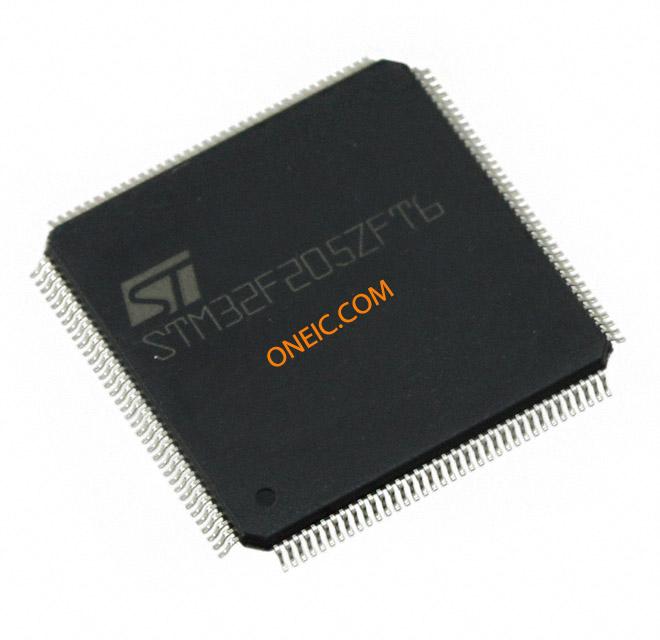
STM32-144LQFP
Image Preview