STM32F103VFT6
32-bit ARM Cortex M3 microcontrollers with 768KB flash memory
Manufacturer: stm
series introduction
# Introduction to the STM32F103VFT6 Product Series
## 1. Overview
The STM32F103VFT6 belongs to the STM32F103 Value Line series of microcontrollers developed by STMicroelectronics. This series is renowned for offering a cost - effective yet high - performance solution for a wide range of embedded applications. The STM32F103VFT6, in particular, combines advanced processing capabilities, rich peripheral interfaces, and low power consumption, making it an ideal choice for various industrial, consumer, and automotive applications.
## 2. Core and Architecture
### 2.1 ARM Cortex - M3 Core
The STM32F103VFT6 is based on the ARM Cortex - M3 32 - bit RISC core. This core features a Harvard architecture with separate instruction and data buses, enabling simultaneous access to instructions and data. It operates at a maximum frequency of 72 MHz, providing high - speed processing capabilities. The Cortex - M3 core also includes a nested vectored interrupt controller (NVIC), which allows for efficient handling of multiple interrupt sources, reducing interrupt latency and improving system responsiveness.
### 2.2 Memory Architecture
- **Flash Memory**: It is equipped with 1 MB of embedded Flash memory. This non - volatile memory is used to store the program code. The Flash memory has a high - speed access time, which ensures fast execution of instructions. It also supports in - system programming (ISP) and in - application programming (IAP), allowing developers to update the firmware remotely or during the operation of the device.
- **SRAM**: The microcontroller has 96 KB of static random - access memory (SRAM). SRAM is used for storing variables, data buffers, and the stack during program execution. The large SRAM capacity enables the implementation of complex algorithms and data - intensive applications.
## 3. Peripheral Interfaces
### 3.1 Communication Interfaces
- **USART (Universal Synchronous/Asynchronous Receiver/Transmitter)**: The STM32F103VFT6 has 3 USART interfaces. These interfaces support both synchronous and asynchronous communication modes, making them suitable for a variety of applications such as serial communication with sensors, modems, and other microcontrollers. They can operate at high baud rates, up to 4.5 Mbps, ensuring fast data transfer.
- **SPI (Serial Peripheral Interface)**: There are 2 SPI interfaces available. SPI is a high - speed serial communication protocol that allows for full - duplex communication between the microcontroller and external devices such as flash memories, sensors, and displays. It supports multiple master - slave configurations and can operate at clock frequencies up to 18 MHz.
- **I2C (Inter - Integrated Circuit)**: With 2 I2C interfaces, the microcontroller can communicate with a wide range of I2C - compatible devices, including EEPROMs, sensors, and LCD controllers. The I2C interface operates in standard, fast, and fast - plus modes, providing flexibility in terms of data transfer rates.
- **CAN (Controller Area Network)**: It features a CAN interface, which is widely used in automotive and industrial applications for reliable communication between multiple nodes in a network. The CAN interface supports both the CAN 2.0A and CAN 2.0B protocols and can operate at bit rates up to 1 Mbps.
### 3.2 Timers
- **General - Purpose Timers**: The STM32F103VFT6 is equipped with 4 general - purpose timers. These timers can be used for a variety of applications, such as generating PWM (Pulse Width Modulation) signals for motor
Images for reference

100-LQFP
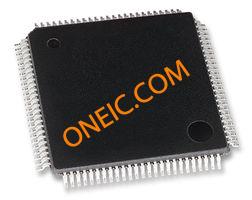
Image Preview
Image Preview