STM32F103V8
32-bit ARM Cortex M3 microcontrollers with 64KB flash, 20KB RAM
Manufacturer: stm
series introduction
# Introduction to the STM32F103V8 Product Series
## 1. Overview
The STM32F103V8 is part of STMicroelectronics' popular STM32F1 series, which is based on the ARM Cortex - M3 32 - bit RISC core. This product series is designed to offer a high - performance, cost - effective, and energy - efficient solution for a wide range of embedded applications. With its rich set of features and excellent performance, the STM32F103V8 has become a favorite among engineers and developers in various industries.
## 2. Key Features
### 2.1 Core and Performance
- **ARM Cortex - M3 Core**: The STM32F103V8 is powered by the ARM Cortex - M3 core, which provides a high - level of processing performance with a maximum operating frequency of up to 72 MHz. This core offers a Harvard architecture with separate instruction and data buses, enabling efficient data transfer and execution of instructions.
- **High - Speed Processing**: The combination of the Cortex - M3 core and the high clock frequency allows the STM32F103V8 to handle complex tasks quickly. It can execute instructions at a rate of up to 1.25 DMIPS/MHz, making it suitable for applications that require real - time processing, such as motor control and industrial automation.
### 2.2 Memory
- **Flash Memory**: It comes with 64 KB of on - chip flash memory. This non - volatile memory is used to store the program code, allowing developers to write and store their applications directly on the microcontroller. The flash memory has a high endurance, which means it can withstand a large number of write and erase cycles, making it reliable for long - term use.
- **SRAM**: The STM32F103V8 is equipped with 20 KB of static random - access memory (SRAM). SRAM is used for storing data during the execution of the program, such as variables, buffers, and stack space. The relatively large SRAM size provides sufficient space for most applications, enabling smooth data processing.
### 2.3 Peripherals
- **GPIO Ports**: The microcontroller has a large number of general - purpose input/output (GPIO) pins. These pins can be configured as either inputs or outputs, allowing for easy connection to external devices such as sensors, actuators, and displays. The GPIO pins also support various modes, including push - pull, open - drain, and pull - up/down resistors, providing flexibility in different application scenarios.
- **Timers**: It includes multiple timers, such as general - purpose timers, advanced - control timers, and basic timers. These timers can be used for a variety of functions, such as generating PWM signals for motor control, measuring time intervals, and creating delays. The advanced - control timers can also be used for more complex applications, such as controlling brushless DC motors.
- **Communication Interfaces**: The STM32F103V8 offers a rich set of communication interfaces, including SPI (Serial Peripheral Interface), I2C (Inter - Integrated Circuit), USART (Universal Synchronous/Asynchronous Receiver/Transmitter), and CAN (Controller Area Network). These interfaces enable the microcontroller to communicate with other devices, such as sensors, displays, and other microcontrollers, facilitating the development of complex systems.
- **Analog - to - Digital Converter (ADC)**: The microcontroller is equipped with a 12 - bit ADC with up to 16 channels. The ADC can be used to convert analog signals from sensors, such as temperature sensors and pressure sensors, into digital values that can be processed by the microcontroller
Images for reference

100-LFBGA

100-LQFP
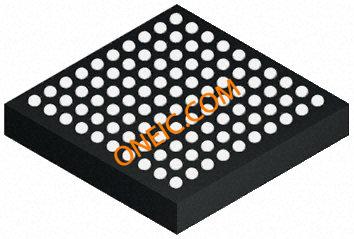
Image Preview