STM32F103RD
32-bit ARM Cortex M3 microcontrollers with 384KB flash memory
Manufacturer: stm
series introduction
# Introduction to the STM32F103RD Product Series
## 1. Overview
The STM32F103RD is part of STMicroelectronics' popular STM32F103 series, which belongs to the ARM® Cortex® - M3 32 - bit microcontroller family. These microcontrollers are designed to offer a high - performance, cost - effective, and energy - efficient solution for a wide range of embedded applications. The "RD" in the model number typically indicates a specific configuration in terms of flash memory size, pin count, and other features.
## 2. Key Features
### 2.1 Core and Performance
- **ARM Cortex - M3 Core**: The STM32F103RD is powered by the ARM Cortex - M3 core, which provides a high - performance 32 - bit RISC architecture. It has a Harvard architecture with separate instruction and data buses, enabling concurrent access to instructions and data, thus improving processing speed. The core can operate at a maximum frequency of up to 72 MHz, delivering excellent computational power for various applications.
- **High - Speed Processing**: With a single - cycle multiplier and hardware division, the STM32F103RD can perform complex arithmetic operations quickly. It also supports a wide range of data types, including 8 - bit, 16 - bit, and 32 - bit, allowing for efficient handling of different data requirements.
### 2.2 Memory
- **Flash Memory**: The "RD" variant usually comes with 256 KB of on - chip flash memory. This non - volatile memory is used to store the program code, allowing developers to write and store their applications directly on the microcontroller. The flash memory has a high endurance, enabling frequent programming and erasing cycles.
- **SRAM**: It is equipped with 48 KB of static random - access memory (SRAM). SRAM is used for storing variables, data buffers, and the stack during program execution. The relatively large SRAM size provides sufficient space for handling complex algorithms and data processing tasks.
### 2.3 Peripherals
- **GPIO (General - Purpose Input/Output)**: The STM32F103RD has a large number of GPIO pins, which can be configured as either input or output. These pins can be used to interface with external devices such as sensors, actuators, displays, and switches. The GPIO pins support various modes, including push - pull, open - drain, and alternate function modes, providing flexibility in system design.
- **Timers**: It includes multiple timers, such as general - purpose timers, advanced - control timers, and basic timers. These timers can be used for a variety of applications, including pulse - width modulation (PWM) generation for motor control, frequency measurement, and delay generation. The advanced - control timers can generate complex PWM waveforms with dead - time insertion, which is essential for driving power electronics devices.
- **Communication Interfaces**:
- **UART (Universal Asynchronous Receiver/Transmitter)**: Multiple UART interfaces are available for asynchronous serial communication. UART is commonly used for communication with other microcontrollers, sensors, and serial devices such as Bluetooth modules and GPS receivers.
- **SPI (Serial Peripheral Interface)**: The SPI interface allows for high - speed synchronous serial communication between the microcontroller and external devices. It is often used for communicating with flash memories, sensors, and display drivers.
- **I²C (Inter - Integrated Circuit)**: The I²C interface is a multi - master, multi - slave serial communication protocol. It is widely used for connecting low - speed devices such as EEPROMs, sensors, and real - time clocks.
- **
Images for reference
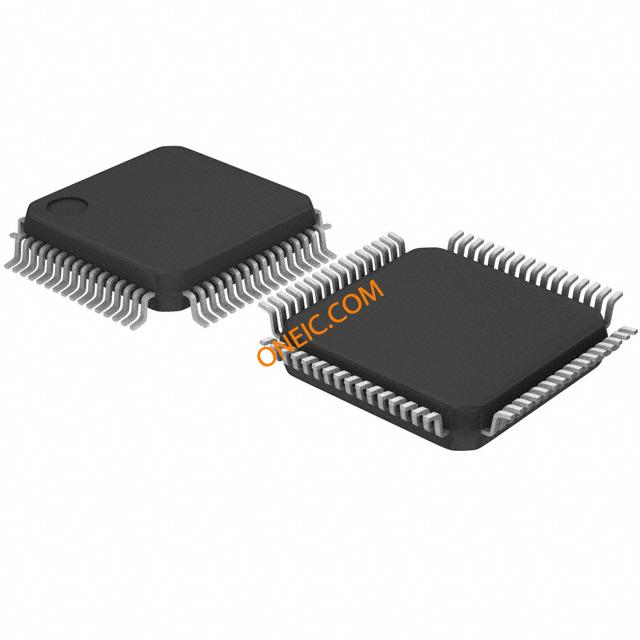
64-LQFP
Image Preview
Image Preview