STM3210C-EVAL
ARM Cortex-M3 microcontroller development and evaluation boards
Manufacturer: stm
series introduction
# Introduction to the STM3210C - EVAL Product Series
## 1. Overview
The STM3210C - EVAL product series is a comprehensive evaluation board solution developed by STMicroelectronics, a leading player in the semiconductor industry. This series is specifically designed to provide engineers, hobbyists, and students with a convenient and efficient platform to evaluate, develop, and prototype applications based on the STM32 microcontroller family. It serves as a bridge between the theoretical knowledge of microcontroller programming and the practical implementation of real - world projects.
## 2. Key Features
### 2.1 Microcontroller
- **Powerful Core**: The board is centered around a high - performance STM32 microcontroller. It typically features an ARM Cortex - M core, which offers a good balance between processing power and energy efficiency. This core can handle complex tasks such as real - time data processing, control algorithms, and communication protocols with ease.
- **Rich Peripherals**: The microcontroller on the STM3210C - EVAL comes equipped with a wide range of built - in peripherals. These include multiple UART (Universal Asynchronous Receiver - Transmitter) interfaces for serial communication, SPI (Serial Peripheral Interface) for high - speed data transfer, I2C (Inter - Integrated Circuit) for connecting low - speed devices like sensors and EEPROMs, and GPIO (General - Purpose Input/Output) pins that can be configured for various functions according to the application requirements.
### 2.2 Memory
- **Flash Memory**: A sufficient amount of on - board flash memory is provided, which is used to store the program code. This allows developers to write and store relatively large applications, enabling the implementation of complex algorithms and features.
- **RAM**: Adequate RAM is available for data storage during the execution of the program. It is used to hold variables, buffers, and intermediate results, ensuring smooth operation of the application.
### 2.3 Connectivity
- **USB Interface**: The board is equipped with a USB port, which serves multiple purposes. It can be used for programming the microcontroller, providing power to the board, and establishing a communication link between the board and a host computer. This makes it easy to transfer data and update the firmware.
- **Ethernet Interface**: For applications that require network connectivity, the STM3210C - EVAL may include an Ethernet interface. This enables the board to communicate with other devices on a local area network (LAN) or the Internet, facilitating functions such as remote monitoring and control.
### 2.4 Display and User Interface
- **LCD Display**: Some versions of the STM3210C - EVAL may feature an LCD (Liquid Crystal Display) screen. This display can be used to show important information such as sensor readings, system status, and user - defined messages, providing a visual interface for the user.
- **Buttons and LEDs**: The board is usually equipped with a set of push - buttons and LEDs. The buttons can be used as input devices for user interaction, while the LEDs can be used to indicate the status of the system, such as power on/off, data transmission, or error conditions.
### 2.5 Expansion Options
- **Expansion Headers**: The board is designed with expansion headers that allow users to connect external modules and sensors. This provides flexibility for customizing the board according to specific application needs. For example, users can connect additional sensors like temperature sensors, accelerometers, or wireless communication modules.
## 3. Development Tools and Software Support
### 3.1 Integrated Development Environment (IDE)
- The STM3210C - EVAL is compatible with popular IDEs such as Keil uVision and STM32CubeIDE. These IDE
Images for reference

STM3210C-EVA
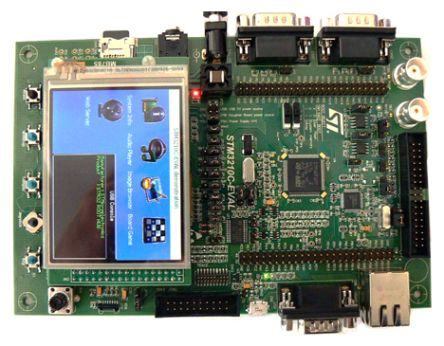
Image Preview

Image Preview