PIC24FJ128GA006-I/MR
16-bit microcontrollers with 128KB flash and 53 I/O pins
Manufacturer: microchip
series introduction
# Introduction to the PIC24FJ128GA006 - I/MR Product Series
## 1. Overview
The PIC24FJ128GA006 - I/MR is a member of Microchip Technology's PIC24F family of 16 - bit microcontrollers. This product series is designed to offer a high - performance, cost - effective solution for a wide range of embedded applications. With its rich set of features, it provides developers with the flexibility and power needed to create innovative and efficient systems.
## 2. Key Features
### 2.1 Core and Performance
- **16 - bit RISC Core**: The PIC24FJ128GA006 - I/MR is built around a 16 - bit RISC (Reduced Instruction Set Computing) core. This architecture allows for efficient execution of instructions, enabling fast processing of data and algorithms. It can handle complex tasks with ease, making it suitable for applications that require real - time processing.
- **High - Speed Operation**: It operates at a maximum frequency of [X] MHz, which ensures quick response times and smooth operation of the system. This high - speed performance is crucial for applications such as motor control, where precise timing is required.
### 2.2 Memory
- **Flash Program Memory**: The microcontroller comes with 128 KB of in - system programmable Flash memory. This large amount of memory allows developers to store complex programs, including firmware updates and application code. The Flash memory is non - volatile, meaning that the stored data is retained even when the power is turned off.
- **RAM Memory**: It has [X] KB of RAM (Random Access Memory), which provides sufficient space for data storage during program execution. The RAM is used for variables, buffers, and stack operations, enabling efficient data handling and processing.
### 2.3 Peripherals
#### 2.3.1 Communication Peripherals
- **UART (Universal Asynchronous Receiver - Transmitter)**: The PIC24FJ128GA006 - I/MR features one or more UART modules, which are used for serial communication. UART allows the microcontroller to communicate with other devices, such as sensors, displays, and computers, using a simple serial protocol. This makes it easy to integrate the microcontroller into existing systems.
- **SPI (Serial Peripheral Interface)**: The SPI interface provides a high - speed, synchronous serial communication method. It is commonly used for communicating with external devices such as EEPROMs, ADCs (Analog - to - Digital Converters), and DACs (Digital - to - Analog Converters). The SPI interface supports multiple slave devices, allowing for easy expansion of the system.
- **I²C (Inter - Integrated Circuit)**: The I²C interface is a multi - master, multi - slave serial communication protocol. It is widely used for connecting low - speed devices, such as sensors and real - time clocks, to the microcontroller. The I²C interface simplifies the wiring and reduces the number of pins required for communication.
#### 2.3.2 Analog Peripherals
- **ADC (Analog - to - Digital Converter)**: The microcontroller is equipped with an ADC module, which can convert analog signals from sensors into digital values. The ADC has a high resolution and sampling rate, allowing for accurate measurement of analog quantities such as temperature, pressure, and voltage.
- **DAC (Digital - to - Analog Converter)**: Some versions of the PIC24FJ128GA006 - I/MR may include a DAC module, which can convert digital signals into analog voltages. This is useful for applications such as audio output and motor control, where analog signals are required.
#### 2.3.3
Images for reference
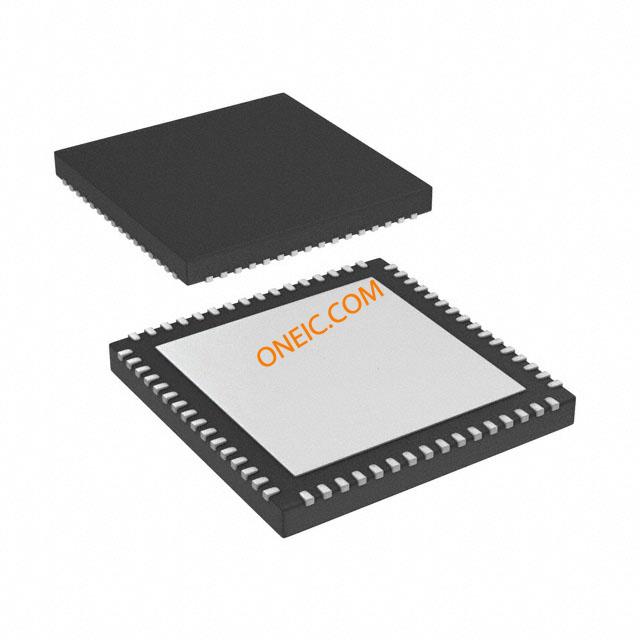
64-QFN

Image Preview