PIC18F452-I/PT
8-bit PIC microcontrollers with 32KB flash, 44-pin TQFP packaging
Manufacturer: microchip
series introduction
# Introduction to the PIC18F452-I/PT Product Series
## 1. Overview
The PIC18F452 - I/PT is a member of Microchip Technology's popular PIC18F microcontroller family. Microcontrollers in this series are designed to offer a high - performance, cost - effective solution for a wide range of embedded applications. The "I/PT" in the part number indicates the specific package type and temperature range, with the device typically coming in a 40 - pin Plastic TQFP (Thin Quad Flat Package) and being suitable for industrial temperature ranges.
## 2. Key Features
### 2.1 CPU and Memory
- **High - Performance CPU**: The PIC18F452 is powered by an enhanced Harvard architecture 8 - bit RISC (Reduced Instruction Set Computing) CPU. It has a wide range of instructions that can be executed in a single cycle, enabling fast processing speeds. The CPU can operate at clock frequencies up to 40 MHz, which allows for efficient execution of complex algorithms and real - time tasks.
- **Program Memory**: It comes with 32 KB of Flash program memory. Flash memory is non - volatile, meaning that the program code stored in it is retained even when the power is turned off. This makes it ideal for applications where the program needs to be stored permanently, such as in industrial control systems and consumer electronics.
- **Data Memory**: The microcontroller has 1536 bytes of RAM (Random Access Memory). RAM is used for storing temporary data during the execution of the program, such as variables, buffers, and intermediate results. The sufficient amount of RAM in the PIC18F452 allows for the implementation of more complex algorithms and data - handling tasks.
### 2.2 Peripherals
#### 2.2.1 Input/Output Ports
- The PIC18F452 features multiple I/O ports, including PORT A, PORT B, PORT C, PORT D, and PORT E. These ports can be configured as either input or output ports, providing flexibility for interfacing with external devices. For example, PORT B can be used to interface with switches or sensors as an input, while PORT C can be used to control LEDs or other output devices.
- Some of the I/O pins also have alternate functions, such as being used for serial communication or analog - to - digital conversion, which further enhances the device's versatility.
#### 2.2.2 Serial Communication Interfaces
- **USART (Universal Synchronous Asynchronous Receiver Transmitter)**: This interface allows the PIC18F452 to communicate with other devices using serial communication protocols. It supports both asynchronous and synchronous modes, making it suitable for a variety of applications, such as communicating with computers, sensors, or other microcontrollers.
- **SPI (Serial Peripheral Interface)**: The SPI interface provides a high - speed, full - duplex serial communication option. It is commonly used for communicating with external devices such as EEPROMs, ADCs (Analog - to - Digital Converters), and DACs (Digital - to - Analog Converters).
- **I²C (Inter - Integrated Circuit)**: The I²C interface is a multi - master, multi - slave serial communication protocol. It is widely used for connecting low - speed devices, such as sensors and real - time clocks, to the microcontroller.
#### 2.2.3 Analog - to - Digital Converter (ADC)
The PIC18F452 is equipped with a 10 - bit ADC. The ADC can convert analog input signals from external sensors (such as temperature sensors, light sensors, or pressure sensors) into digital values that can be processed by the microcontroller. It has up to 8 input
Images for reference

44-TQFP
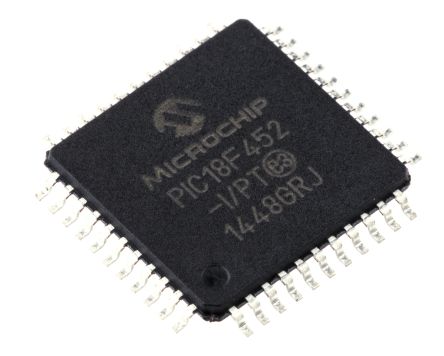
Image Preview

Image Preview