PIC16F88-I/SO
8-bit PIC microcontrollers with flash memory, 18-pin SOIC package
Manufacturer: microchip
series introduction
# PIC16F88-I/SO Product Series Introduction
## 1. Overview
The PIC16F88 - I/SO is part of Microchip Technology's popular PIC16F microcontroller family. These microcontrollers are designed to offer a balance of performance, functionality, and cost - effectiveness, making them suitable for a wide range of embedded applications. The "I/SO" in the part number indicates the specific package type (Small Outline Integrated Circuit - SOIC) and the industrial temperature range, which allows the device to operate reliably in more challenging environmental conditions.
## 2. Key Features
### 2.1 CPU and Memory
- **CPU Architecture**: The PIC16F88 is based on a high - performance RISC (Reduced Instruction Set Computing) architecture. It has a simple and efficient instruction set, with most instructions being executed in a single cycle. This results in fast processing speeds and allows for quick response times in applications.
- **Program Memory**: It comes with 8KB of Flash program memory. Flash memory is non - volatile, which means that the program code stored in it is retained even when the power is turned off. This allows for easy reprogramming during development and in - field updates if required.
- **Data Memory**: The device has 368 bytes of RAM (Random Access Memory). RAM is used for storing temporary data during program execution, such as variables, intermediate results, and stack operations.
### 2.2 Peripherals
#### 2.2.1 Timers
- **Timer0**: This is an 8 - bit timer/counter with an 8 - bit prescaler. It can be used for a variety of timing functions, such as generating time delays, measuring time intervals, and as a real - time clock in simple applications.
- **Timer1**: A 16 - bit timer/counter that can operate in either timer or counter mode. It can be synchronized with an external clock source, making it useful for applications that require precise timing, such as frequency measurement or generating accurate pulse widths.
- **Timer2**: An 8 - bit timer/counter with a 16 - bit period register. It is often used in conjunction with the PWM (Pulse Width Modulation) module to generate PWM signals with variable duty cycles.
#### 2.2.2 Analog - to - Digital Converter (ADC)
The PIC16F88 features a 10 - bit ADC with up to 8 input channels. This allows the microcontroller to convert analog signals from sensors (such as temperature sensors, light sensors, or potentiometers) into digital values that can be processed by the CPU. The ADC has a fast conversion time, enabling real - time monitoring of analog signals.
#### 2.2.3 Comparators
It includes two analog comparators. These comparators can be used to compare two analog voltages and generate a digital output based on the comparison result. They are useful in applications such as voltage monitoring, level detection, and motor control.
#### 2.2.4 Pulse Width Modulation (PWM)
The device has two independent PWM modules. PWM is a technique used to control the power delivered to a load by varying the duty cycle of a square wave. The PWM modules in the PIC16F88 can be used for applications such as motor speed control, LED brightness control, and power supply regulation.
### 2.3 Communication Interfaces
- **Universal Synchronous Asynchronous Receiver Transmitter (USART)**: The USART allows the microcontroller to communicate with other devices using either asynchronous serial communication (such as RS - 232) or synchronous serial communication (such as SPI in master mode). This enables the PIC16F88 to interface with a wide range of external devices, including computers
Images for reference
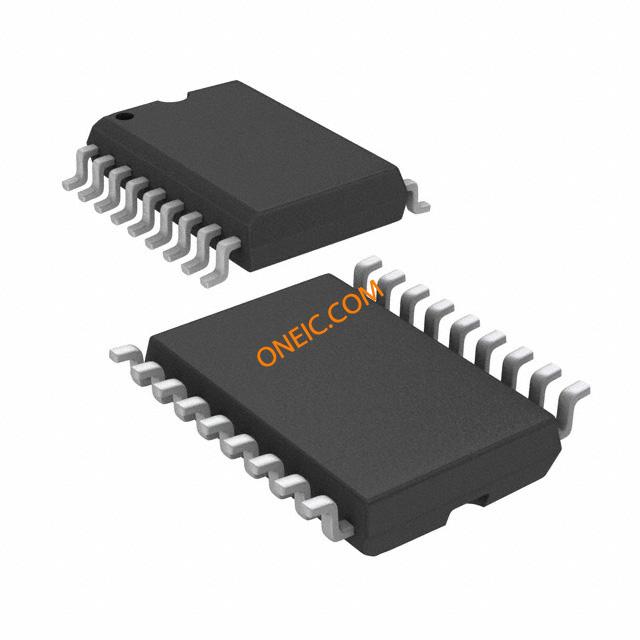
18-SOIC

18-SOIC,DW

Image Preview