PIC16F870-I/SP
8-bit PIC microcontrollers with flash memory, 28-pin SPDIP packaging
Manufacturer: microchip
series introduction
# PIC16F870-I/SP Product Series Introduction
## 1. Overview
The PIC16F870 - I/SP belongs to Microchip Technology's PIC16F87X family of 8 - bit microcontrollers. These microcontrollers are well - known for their high performance, low power consumption, and rich set of on - chip peripherals, making them suitable for a wide range of embedded applications. The "I/SP" in the part number typically indicates a specific package type and other associated characteristics, often referring to a surface - mount package that is convenient for modern printed circuit board (PCB) assembly processes.
## 2. Key Features
### 2.1 CPU and Memory
- **CPU Core**: It is based on a high - performance RISC (Reduced Instruction Set Computing) architecture. This architecture simplifies the instruction set, allowing for faster execution times and efficient code development. The CPU can execute most instructions in a single instruction cycle, which significantly enhances the overall processing speed.
- **Program Memory**: The PIC16F870 - I/SP is equipped with a certain amount of Flash program memory. Flash memory is non - volatile, meaning that the program code stored in it is retained even when the power is turned off. This allows for easy reprogramming during the development phase and in - field updates if required.
- **Data Memory**: It has a data memory (RAM) that provides space for storing variables, intermediate results, and other data during program execution. The organization of the data memory is designed to optimize access speed and efficient use of resources.
### 2.2 Peripherals
#### 2.2.1 Input/Output Ports
- Multiple general - purpose input/output (GPIO) ports are available. These ports can be configured as either inputs or outputs, allowing the microcontroller to interface with a variety of external devices such as sensors, switches, and actuators. The GPIO ports can be individually controlled, enabling precise control over the connected external components.
- Some ports may have additional features like weak pull - up resistors, which can be enabled or disabled as needed. This is useful when interfacing with external devices that require a specific input voltage level.
#### 2.2.2 Timer/Counters
- The device includes several timer/counter modules. These timers can be used for a variety of purposes, such as generating time delays, measuring time intervals, and generating periodic signals. For example, they can be used to control the speed of a motor by generating a pulse - width modulation (PWM) signal.
- The timer/counter modules can operate in different modes, including timer mode (counting internal clock pulses) and counter mode (counting external events).
#### 2.2.3 Analog - to - Digital Converter (ADC)
- An on - chip ADC is provided, which allows the microcontroller to convert analog signals from sensors (such as temperature sensors, light sensors, etc.) into digital values that can be processed by the CPU. The ADC typically has a certain number of channels, enabling it to sample multiple analog inputs.
- It offers a specific resolution (e.g., 8 - bit or 10 - bit), which determines the accuracy of the analog - to - digital conversion.
#### 2.2.4 Serial Communication Interfaces
- **USART (Universal Synchronous/Asynchronous Receiver/Transmitter)**: This interface enables the microcontroller to communicate with other devices using serial communication protocols. It can operate in both synchronous and asynchronous modes, allowing for flexible communication with a wide range of external devices such as serial displays, modems, and other microcontrollers.
- **SPI (Serial Peripheral Interface)**: SPI is a high - speed serial communication protocol that allows the microcontroller to communicate with other SPI - compatible devices. It is often
Images for reference
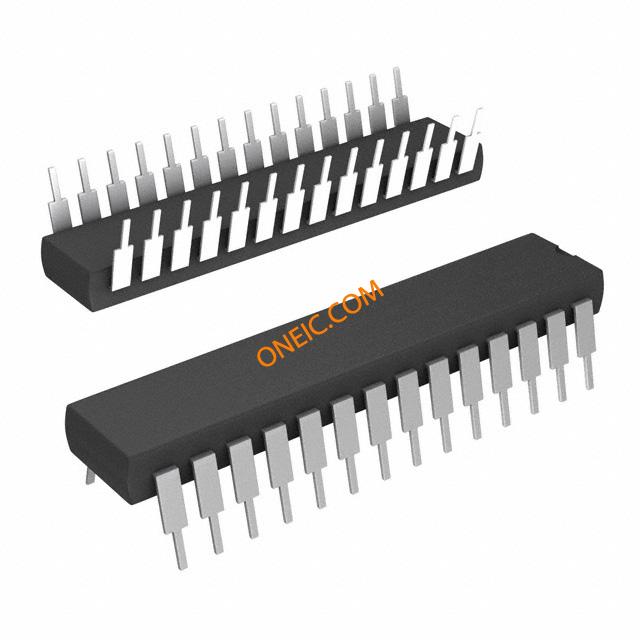
28-DIP

28-DIP

Image Preview