P89LPC9408FBD
8-bit microcontrollers with flash memory and LCD driver support
Manufacturer: nxp
series introduction
# Introduction to the P89LPC9408FBD Product Series
## 1. Overview
The P89LPC9408FBD is a highly versatile and feature - rich microcontroller product series developed by NXP. It belongs to the 8051 - based family of microcontrollers, which are well - known for their wide - spread use in various embedded systems due to their simplicity, reliability, and cost - effectiveness. This product series is designed to meet the diverse requirements of modern electronic applications, offering a balance between performance, functionality, and power consumption.
## 2. Key Features
### 2.1 Core and Architecture
- **8051 Core**: The P89LPC9408FBD is built around an enhanced 8051 core. This core provides a familiar programming environment for developers who are already experienced with the 8051 architecture. It supports a wide range of instructions, allowing for efficient implementation of complex algorithms.
- **High - Speed Operation**: It can operate at relatively high clock frequencies, enabling fast execution of code. This high - speed operation is crucial for applications that require real - time processing, such as motor control and sensor data acquisition.
### 2.2 Memory
- **Flash Memory**: The microcontroller is equipped with on - chip Flash memory. The P89LPC9408FBD typically has a sufficient amount of Flash memory (e.g., 16KB or more) to store the user's program code. Flash memory is non - volatile, which means that the program remains stored even when the power is turned off. This allows for easy reprogramming during development and in - field updates.
- **Data Memory**: It also has a certain amount of on - chip data memory (RAM). This RAM is used for storing variables, intermediate results, and stack operations during program execution. The available data memory size is optimized to meet the requirements of most embedded applications.
### 2.3 Peripherals
#### 2.3.1 I/O Ports
- The P89LPC9408FBD has multiple general - purpose input/output (GPIO) ports. These ports can be configured as either inputs or outputs, allowing the microcontroller to interface with a variety of external devices such as sensors, actuators, and displays. The GPIO ports are also programmable in terms of their drive strength and pull - up/down resistors, providing flexibility in different application scenarios.
#### 2.3.2 Serial Communication Interfaces
- **UART (Universal Asynchronous Receiver/Transmitter)**: It features a UART interface, which is commonly used for asynchronous serial communication. This interface allows the microcontroller to communicate with other devices such as computers, modems, and other microcontrollers over a serial link. UART communication is widely used in applications like data logging, remote monitoring, and industrial control.
- **SPI (Serial Peripheral Interface)**: The SPI interface provides a high - speed synchronous serial communication option. It is often used to communicate with external devices such as EEPROMs, ADCs (Analog - to - Digital Converters), and DACs (Digital - to - Analog Converters). SPI offers faster data transfer rates compared to UART, making it suitable for applications that require high - speed data exchange.
#### 2.3.3 Timer/Counters
- The microcontroller includes multiple timer/counters. These can be used for a variety of purposes, such as generating accurate time delays, measuring time intervals, and generating pulse - width modulation (PWM) signals. PWM signals are commonly used in motor control applications to control the speed and direction of motors.
#### 2.3.4 Analog - to - Digital Converter (ADC)
- The P89LPC94
Images for reference
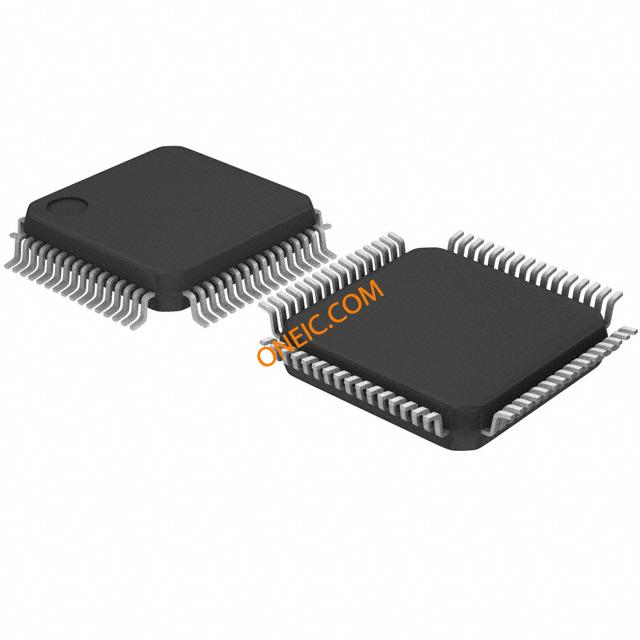
64-LQFP
Image Preview