MSP430F5328IRGC
16-bit mixed-signal microcontrollers with 128KB flash, 10KB RAM, 64-pin VQFN
Manufacturer: ti
series introduction
# Introduction to the MSP430F5328IRGC Product Series
## 1. Overview
The MSP430F5328IRGC belongs to the MSP430 microcontroller family developed by Texas Instruments. This product series is renowned for its high - performance, low - power consumption, and rich peripheral features, making it an ideal choice for a wide range of applications in the embedded systems domain.
## 2. Key Features
### 2.1 Low - Power Architecture
- **Multiple Power Modes**: The MSP430F5328IRGC offers several power modes, including active mode, standby mode, and various levels of sleep modes. In standby mode, the microcontroller can quickly wake up in response to an external event while consuming minimal power. For example, in some low - power sleep modes, the power consumption can be as low as a few microamps, which is crucial for battery - powered applications such as wearable devices and wireless sensor nodes.
- **Dynamic Voltage Scaling**: It supports dynamic voltage scaling, which allows the microcontroller to adjust its operating voltage according to the processing requirements. This feature further optimizes power consumption by reducing the voltage when the system is performing less demanding tasks.
### 2.2 High - Performance CPU
- **16 - Bit RISC CPU**: The MSP430F5328IRGC is equipped with a 16 - bit Reduced Instruction Set Computing (RISC) CPU. This architecture provides a high level of code efficiency and fast execution speed. The CPU can execute instructions in a single clock cycle for many operations, enabling real - time processing of data.
- **High Clock Speeds**: It can operate at relatively high clock speeds, up to 25 MHz. This high clock frequency allows the microcontroller to handle complex algorithms and perform tasks such as data encryption, signal processing, and communication protocol handling efficiently.
### 2.3 Rich Peripherals
#### 2.3.1 Timers
- **Multiple Timers**: The device comes with multiple timers, including Timer_A and Timer_B. These timers can be used for a variety of purposes, such as generating PWM (Pulse Width Modulation) signals for motor control, measuring time intervals, and implementing real - time scheduling. For example, in a motor control application, the PWM signals generated by the timers can be used to control the speed and direction of the motor.
- **Capture and Compare Modes**: The timers support capture and compare modes. In capture mode, they can record the time at which an external event occurs, which is useful for applications such as frequency measurement. In compare mode, they can generate interrupts or output signals at specific time intervals.
#### 2.3.2 Communication Interfaces
- **UART (Universal Asynchronous Receiver - Transmitter)**: The MSP430F5328IRGC has a UART interface, which is widely used for serial communication. It can communicate with other devices such as computers, sensors, and actuators using standard serial protocols. This makes it easy to integrate the microcontroller into existing systems.
- **SPI (Serial Peripheral Interface)**: The SPI interface provides a high - speed serial communication option. It allows the microcontroller to communicate with other SPI - compatible devices, such as external memory chips or display modules, at data transfer rates of up to several megabits per second.
- **I²C (Inter - Integrated Circuit)**: The I²C interface is a multi - master, multi - slave serial communication protocol. It is commonly used for connecting low - speed devices such as sensors and EEPROMs. The MSP430F5328IRGC's I²C interface supports both master and slave modes, providing flexibility in system design.
Images for reference

64-VQFN

64-VFQFN Exposed Pad
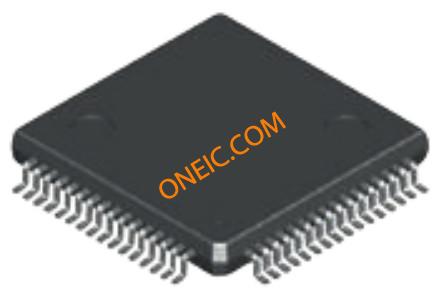
Image Preview