MSP430F169IPMR
16-bit ultra-low-power microcontrollers with flash memory and multiple interfaces
Manufacturer: ti
series introduction
# Introduction to the MSP430F169IPMR Product Series
## 1. Overview
The MSP430F169IPMR is part of Texas Instruments' highly regarded MSP430 microcontroller family. Renowned for its ultra - low power consumption, high performance, and rich peripheral integration, this product series is a popular choice for a wide range of applications, from battery - powered devices to industrial control systems.
## 2. Key Features
### 2.1 Processor Core
- **16 - bit RISC Architecture**: The MSP430F169IPMR is built around a 16 - bit RISC (Reduced Instruction Set Computing) CPU. This architecture offers a high level of code efficiency, allowing developers to write compact and fast - executing programs. It can perform complex arithmetic and logical operations with ease, making it suitable for applications that require real - time data processing.
- **High - Speed Operation**: With a clock speed that can reach up to 8 MHz, the microcontroller can handle tasks quickly. This speed is sufficient for many applications, such as sensor data acquisition and simple control algorithms.
### 2.2 Memory
- **Flash Memory**: It comes equipped with 60 KB of in - system programmable Flash memory. This non - volatile memory allows developers to store their application code and data. The Flash memory can be easily reprogrammed, enabling quick prototyping and firmware updates in the field.
- **RAM**: There is 2 KB of RAM available for storing variables, intermediate results, and stack operations during program execution. The sufficient amount of RAM ensures smooth operation of moderately complex applications.
### 2.3 Power Management
- **Ultra - Low Power Modes**: One of the standout features of the MSP430F169IPMR is its excellent power management capabilities. It offers five low - power modes, ranging from standby modes with very low current consumption to active modes for full - performance operation. In standby mode, the current consumption can be as low as a few microamps, making it ideal for battery - powered devices where long battery life is crucial.
- **Dynamic Power Scaling**: The microcontroller can dynamically adjust its power consumption based on the application's requirements. For example, during periods of low activity, it can automatically enter a low - power mode, and when a task needs to be executed, it can quickly wake up and resume normal operation.
### 2.4 Peripherals
#### 2.4.1 Timers
- **Multiple Timers**: The MSP430F169IPMR includes several timers, such as the Timer_A and Timer_B modules. These timers can be used for a variety of purposes, including generating accurate time delays, pulse - width modulation (PWM) for motor control, and capturing external events.
- **Flexible Configuration**: The timers offer multiple operating modes and can be configured to work independently or in combination with other peripherals. This flexibility allows developers to customize the timer functionality according to their specific application needs.
#### 2.4.2 Analog - to - Digital Converter (ADC)
- **12 - bit ADC**: It features a 12 - bit ADC with up to 16 input channels. This high - resolution ADC can accurately convert analog signals from sensors, such as temperature sensors, pressure sensors, and light sensors, into digital values. The multiple input channels enable simultaneous sampling of multiple analog signals, which is useful in multi - sensor applications.
- **Fast Conversion Speed**: The ADC has a relatively fast conversion speed, allowing for real - time data acquisition. This is important in applications where timely response to changes in the analog environment is required.
#### 2.4.3 Universal Serial Communication Interfaces
- **UART, SPI, and
Images for reference
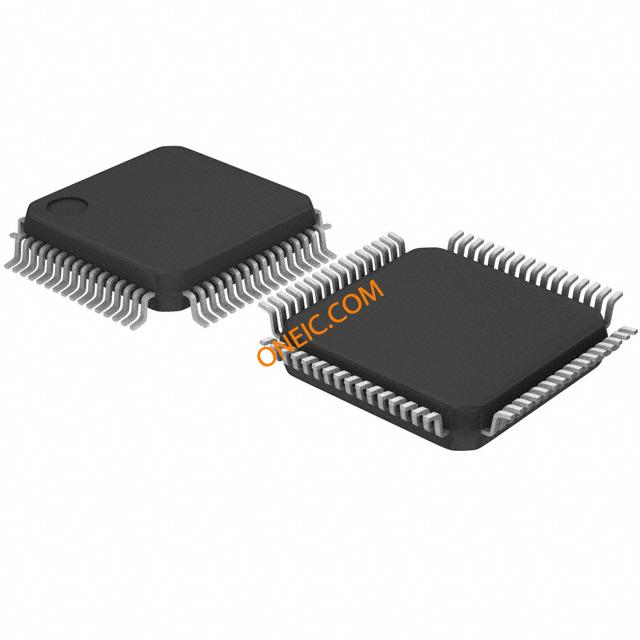
64-LQFP
Image Preview

Image Preview