MCF5274CVM166
32-bit RISC microprocessors for advanced computing applications
Manufacturer: ['freescale', 'nxp']
series introduction
# Introduction to the MCF5274CVM166 Product Series
## 1. Overview
The MCF5274CVM166 is a remarkable member of a product series that belongs to the ColdFire family of microcontrollers developed by Freescale Semiconductor (now NXP Semiconductors). These microcontrollers are designed to offer high - performance, low - power solutions for a wide range of embedded applications. The "MCF5274" is the core model identifier, "CVM" represents a specific package and configuration, and "166" indicates the operating frequency of the device, which runs at 166 MHz.
## 2. Key Features
### 2.1 Processor Core
- **ColdFire V2 Core**: The MCF5274CVM166 is built around the ColdFire V2 core architecture. This architecture provides a high - performance 32 - bit RISC (Reduced Instruction Set Computing) processor. It offers a rich set of instructions that are optimized for efficient execution, enabling fast data processing and complex algorithm implementation.
- **High - Speed Operation**: With an operating frequency of 166 MHz, the microcontroller can handle tasks quickly, making it suitable for applications that require real - time processing, such as industrial control systems, automotive electronics, and networking devices.
### 2.2 Memory
- **Internal Memory**: It comes with a significant amount of on - chip memory. This includes a certain amount of flash memory, which is non - volatile and can be used to store the program code. The flash memory allows for easy firmware updates, enabling developers to enhance the functionality of the device over time. Additionally, there is also on - chip SRAM (Static Random - Access Memory) that provides fast access to data during program execution, reducing the need for external memory in many applications.
- **External Memory Interface**: The MCF5274CVM166 is equipped with an external memory interface, which allows it to interface with external memory devices such as SDRAM (Synchronous Dynamic Random - Access Memory) and flash memory. This expands the memory capacity of the system, enabling the handling of larger programs and data sets.
### 2.3 Peripherals
- **Communication Interfaces**:
- **Ethernet Controller**: It features an integrated Ethernet controller, which supports standard Ethernet protocols such as TCP/IP. This makes it ideal for networking applications, allowing the device to communicate with other devices on a local area network (LAN) or the internet.
- **UART (Universal Asynchronous Receiver - Transmitter)**: Multiple UART interfaces are available, which are commonly used for serial communication. UARTs can be used to communicate with other serial devices such as sensors, displays, and modems.
- **SPI (Serial Peripheral Interface)**: The SPI interface provides a high - speed serial communication option, which is often used to connect to external devices such as flash memory, ADCs (Analog - to - Digital Converters), and DACs (Digital - to - Analog Converters).
- **I²C (Inter - Integrated Circuit)**: The I²C interface is a multi - master, multi - slave serial communication protocol. It is useful for connecting low - speed devices such as sensors, EEPROMs (Electrically Erasable Programmable Read - Only Memory), and other integrated circuits.
- **Timers and Counters**: The microcontroller has a set of timers and counters that can be used for various purposes. These include generating accurate time delays, measuring time intervals, and generating PWM (Pulse - Width Modulation) signals. PWM signals are commonly used in motor control applications to control the speed and direction of motors.
- **Analog - to - Digital Converter (ADC)**: An on
Images for reference
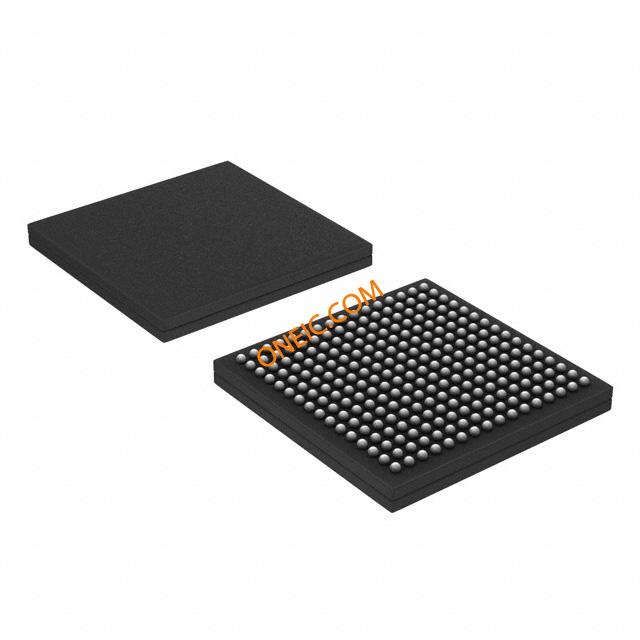
256-LFBGA
Image Preview

Image Preview