MC9S08JM16CGT
8-bit microcontrollers with 16KB flash memory for versatile applications
Manufacturer: ['rochester', 'freescale', 'nxp']
series introduction
# Introduction to the MC9S08JM16CGT Product Series
## 1. Overview
The MC9S08JM16CGT belongs to the MC9S08JM series of microcontrollers developed by NXP Semiconductors. These microcontrollers are designed to offer a cost - effective, high - performance solution for a wide range of embedded applications. With a focus on low power consumption, ease of use, and rich peripheral integration, the MC9S08JM16CGT is well - suited for various consumer, industrial, and automotive applications.
## 2. Core and Architecture
### 2.1 CPU Core
- The MC9S08JM16CGT is based on the HCS08 CPU core. This 8 - bit core offers a good balance between performance and cost. It has a simple instruction set architecture that is easy to program, making it accessible for both novice and experienced embedded developers.
- The core operates at a maximum frequency of up to 20 MHz, which allows for efficient execution of code and handling of real - time tasks. It also features a single - cycle multiply instruction, which can significantly speed up arithmetic operations commonly used in signal processing and control algorithms.
### 2.2 Memory Organization
- **Flash Memory**: It is equipped with 16 KB of in - system programmable flash memory. This non - volatile memory is used to store the application code. The flash memory has a high endurance, allowing for multiple programming and erasing cycles, which is useful for firmware updates during the product's lifecycle.
- **Random - Access Memory (RAM)**: The microcontroller has 1 KB of RAM. This memory is used for storing variables, data buffers, and the stack during program execution. The sufficient amount of RAM enables the implementation of moderately complex algorithms and data - handling tasks.
- **EEPROM**: There is also 512 bytes of electrically erasable programmable read - only memory (EEPROM). EEPROM is ideal for storing configuration data, calibration values, and other non - volatile information that needs to be retained even when the power is turned off.
## 3. Peripherals
### 3.1 Serial Communication Interfaces
- **Serial Peripheral Interface (SPI)**: The MC9S08JM16CGT features an SPI module, which allows for high - speed serial communication with external devices such as sensors, displays, and memory chips. The SPI interface supports master and slave modes, enabling flexible communication topologies.
- **Inter - Integrated Circuit (I2C)**: An I2C interface is also available, which is widely used for connecting low - speed devices in a multi - master or master - slave configuration. It simplifies the connection of components like temperature sensors, real - time clocks, and EEPROMs.
- **Universal Asynchronous Receiver/Transmitter (UART)**: The UART provides asynchronous serial communication, which is commonly used for communication with other microcontrollers, computers, or serial - based devices. It supports various baud rates, making it compatible with a wide range of communication standards.
### 3.2 Timer Modules
- **Flexible Timer Module (FTM)**: The FTM is a versatile timer module that can be used for a variety of applications, including pulse - width modulation (PWM) generation, input capture, and output compare. PWM is commonly used for motor control, LED dimming, and power management applications. The FTM allows for precise control of the duty cycle and frequency of the PWM signals.
- **Real - Time Interrupt (RTI) Timer**: The RTI timer provides a low - power, periodic interrupt source. It can be used for tasks such as power management, where the microcontroller needs to wake up at regular intervals to perform certain operations and then go
Images for reference

48-QFN
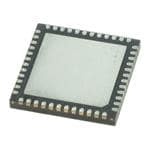
Image Preview