MC9S08DZ60ACLF
8-bit microcontrollers with 60KB flash, 4KB RAM, and CAN/LIN support
Manufacturer: ['freescale', 'nxp']
series introduction
# Introduction to the MC9S08DZ60ACLF Product Series
## 1. Overview
The MC9S08DZ60ACLF is a member of the highly capable and versatile 8 - bit microcontroller product series developed by Freescale (now NXP Semiconductors). This series is designed to meet a wide range of embedded application requirements, offering a balance of performance, functionality, and cost - effectiveness.
## 2. Core and Architecture
### 2.1 CPU Core
- The MC9S08DZ60ACLF is based on the HCS08 CPU core. This 8 - bit core provides a simple yet efficient instruction set architecture, which is well - suited for real - time control applications. It has a relatively low power consumption, making it ideal for battery - powered or energy - sensitive devices.
- The core features a fast interrupt response time, allowing the microcontroller to quickly react to external events. This is crucial in applications where timely processing of input signals is required, such as in motor control or sensor data acquisition.
### 2.2 Memory Architecture
- **Flash Memory**: It comes with 60 KB of in - system programmable flash memory. This non - volatile memory is used to store the application code. The flash memory can be easily reprogrammed, enabling developers to update the firmware of the device during the development process or in the field.
- **RAM**: There is 4 KB of random - access memory (RAM). The RAM is used for storing variables, intermediate results, and data buffers during the execution of the program. Sufficient RAM ensures smooth operation of the application, especially when dealing with complex algorithms or large amounts of data.
- **EEPROM**: The microcontroller also includes 1 KB of electrically erasable programmable read - only memory (EEPROM). EEPROM is useful for storing configuration data, calibration values, or other non - volatile information that needs to be retained even when the power is turned off.
## 3. Peripherals
### 3.1 Timer Modules
- **PIT (Periodic Interrupt Timer)**: The PIT provides accurate and flexible timing functions. It can be used to generate periodic interrupts, which are useful for tasks such as sampling sensor data at regular intervals or implementing time - based control algorithms.
- **TPM (Timer/PWM Module)**: The TPM module can be configured as a timer or a pulse - width modulation (PWM) generator. In PWM mode, it can generate high - resolution PWM signals, which are commonly used in motor control applications to control the speed and direction of motors.
### 3.2 Communication Interfaces
- **SPI (Serial Peripheral Interface)**: The SPI interface allows the microcontroller to communicate with other SPI - compatible devices, such as external sensors, memory chips, or display modules. It provides a high - speed, synchronous serial communication protocol, enabling fast data transfer between the microcontroller and the external devices.
- **UART (Universal Asynchronous Receiver/Transmitter)**: The UART interface is used for asynchronous serial communication. It is commonly used for communication with other microcontrollers, computers, or serial - based devices. UART is a simple and widely used communication protocol, making it easy to integrate the MC9S08DZ60ACLF into existing systems.
- **I²C (Inter - Integrated Circuit)**: The I²C interface is a multi - master, multi - slave serial communication protocol. It is used for communicating with a variety of I²C - compatible devices, such as sensors, EEPROMs, and other integrated circuits. The I²C interface uses a two - wire bus, which simplifies the hardware design and reduces the number of pins required for communication.
### 3.3 Analog - to
Images for reference
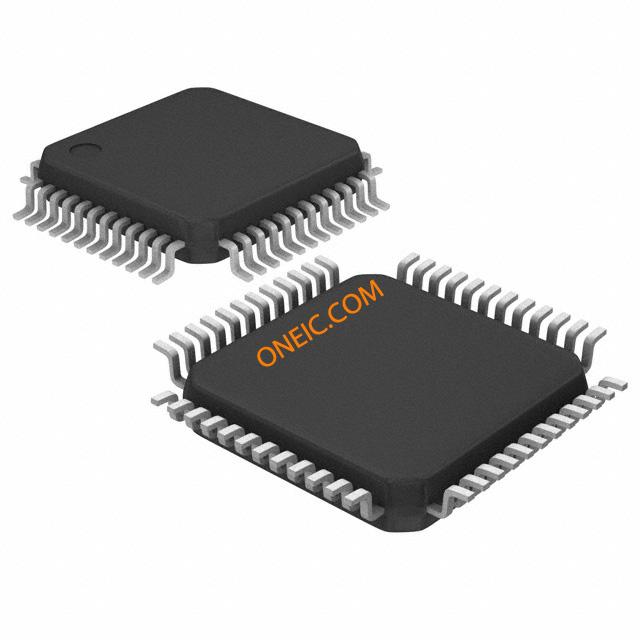
48-LQFP

Image Preview
Image Preview