LPC2368FBD100
32-bit ARM7 microcontrollers with USB, CAN, and Ethernet connectivity
Manufacturer: nxp
series introduction
# Introduction to the LPC2368FBD100 Product Series
## 1. Overview
The LPC2368FBD100 is a highly versatile and powerful microcontroller product series developed by NXP Semiconductors. It belongs to the ARM7 - based LPC2300 family, which is well - known for its excellent performance, rich peripheral integration, and low power consumption. This product series is designed to meet the diverse needs of various embedded applications, ranging from industrial control and automation to consumer electronics and automotive systems.
## 2. Key Features
### 2.1 Processor Core
- **ARM7TDMI - S Core**: The LPC2368FBD100 is built around the ARM7TDMI - S 32 - bit RISC processor core. This core offers a high - performance computing platform with a Harvard architecture, which allows for simultaneous instruction and data access. It operates at a maximum clock frequency of up to 72 MHz, enabling fast execution of complex algorithms and tasks.
- **Thumb Instruction Set**: In addition to the standard ARM instruction set, the core supports the Thumb instruction set, which provides a more compact code size. This is beneficial for applications with limited memory resources, as it reduces the program code footprint while maintaining high performance.
### 2.2 Memory
- **On - Chip Flash Memory**: It comes with 512 KB of on - chip flash memory, which can be used to store the application code. The flash memory has a high - speed access time, allowing for quick execution of the stored programs. It also supports in - system programming (ISP) and in - application programming (IAP), which means that the code can be updated or modified without the need to remove the microcontroller from the circuit board.
- **On - Chip SRAM**: The LPC2368FBD100 is equipped with 40 KB of on - chip SRAM. This SRAM can be used for data storage, stack operations, and as a buffer for data processing. The high - speed SRAM ensures fast data access and manipulation, improving the overall performance of the system.
### 2.3 Peripherals
#### 2.3.1 Communication Interfaces
- **UART (Universal Asynchronous Receiver - Transmitter)**: There are multiple UART interfaces available, which are commonly used for serial communication with other devices such as sensors, displays, and modems. The UARTs support various baud rates and can operate in both asynchronous and synchronous modes.
- **SPI (Serial Peripheral Interface)**: The SPI interface provides a high - speed serial communication protocol, which is suitable for communicating with external devices such as flash memories, ADCs, and DACs. It supports full - duplex communication and can operate at high clock frequencies.
- **I²C (Inter - Integrated Circuit)**: The I²C interface is a widely used serial communication protocol for connecting multiple devices on a single bus. It is commonly used for communicating with sensors, EEPROMs, and other low - speed devices. The LPC2368FBD100 supports both master and slave modes on the I²C interface.
- **CAN (Controller Area Network)**: The CAN interface is designed for automotive and industrial applications where reliable communication between multiple nodes is required. It supports the CAN 2.0A and CAN 2.0B protocols and can operate at high data rates.
#### 2.3.2 Timers and Counters
- **General - Purpose Timers**: The microcontroller has several general - purpose timers, which can be used for a variety of applications such as generating time delays, measuring time intervals, and generating PWM (Pulse Width Modulation) signals. The timers can be configured to operate
Images for reference
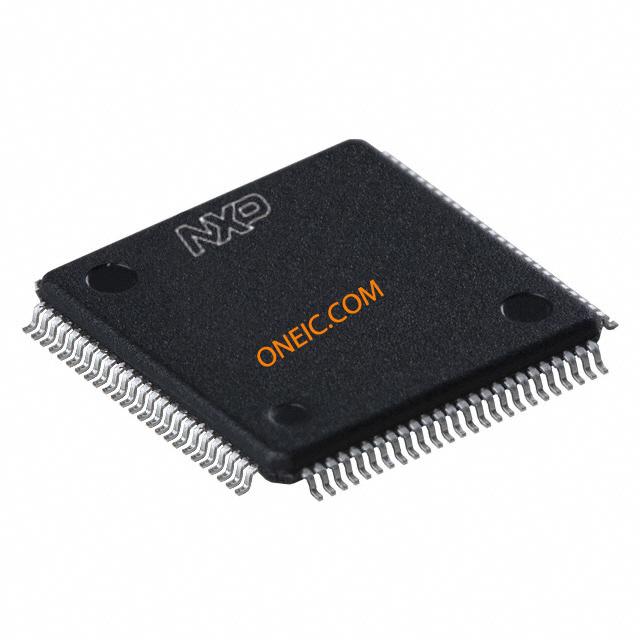
100-LQFP SOT407-1

100-LQFP
Image Preview