LPC2366FBD100
32-bit ARM7 microcontrollers with flash memory and multiple interfaces
Manufacturer: nxp
series introduction
# Introduction to the LPC2366FBD100 Product Series
## 1. Overview
The LPC2366FBD100 is a member of a highly versatile and powerful microcontroller product series developed by NXP Semiconductors. These microcontrollers are designed to meet the diverse requirements of embedded systems across a wide range of industries, including industrial automation, consumer electronics, automotive, and more. The "LPC2366" represents the specific model within the LPC2300 series, while "FBD100" indicates the package type and pin count, in this case, a 100 - pin Fine - Pitch Ball Grid Array (FBGA) package.
## 2. Key Features
### 2.1 Processor Core
- **ARM7TDMI - S Core**: The LPC2366FBD100 is based on the ARM7TDMI - S 32 - bit RISC processor core. This core offers a high - performance computing platform with a clock speed that can reach up to 72 MHz. The ARM7 architecture provides a good balance between performance and power consumption, making it suitable for battery - powered and energy - efficient applications.
- **Thumb Instruction Set**: It supports the Thumb instruction set, which allows for more compact code storage. This is beneficial in applications where memory space is limited, as it reduces the overall code size without sacrificing too much performance.
### 2.2 Memory
- **On - Chip Flash Memory**: The microcontroller comes with 512 KB of on - chip flash memory. This non - volatile memory is used to store the program code, allowing for easy reprogramming and firmware updates. The flash memory has a high - endurance rating, ensuring reliable long - term data storage.
- **Static Random - Access Memory (SRAM)**: There is 96 KB of on - chip SRAM available for data storage and stack operations. The SRAM provides fast access to data, enabling efficient execution of programs and handling of real - time tasks.
### 2.3 Peripherals
#### 2.3.1 Communication Interfaces
- **Universal Asynchronous Receiver/Transmitter (UART)**: It features multiple UART interfaces, which are commonly used for serial communication with other devices such as sensors, displays, and modems. The UARTs support various baud rates and can be configured for different communication protocols, making them highly flexible.
- **Serial Peripheral Interface (SPI)**: The SPI interface allows for high - speed serial communication between the microcontroller and other SPI - compatible devices. It is often used for communicating with external memory chips, sensors, and other peripherals that require fast data transfer.
- **Inter - Integrated Circuit (I2C)**: The I2C interface is a widely used two - wire serial communication protocol. It enables the microcontroller to communicate with a variety of I2C - enabled devices, such as EEPROMs, sensors, and other microcontrollers, in a multi - master or multi - slave configuration.
- **Controller Area Network (CAN)**: The LPC2366FBD100 includes a CAN interface, which is essential for automotive and industrial applications. CAN is a robust communication protocol that allows multiple nodes to communicate over a shared bus, providing high - reliability data transfer in noisy environments.
#### 2.3.2 Timers and Counters
- **Multiple Timers**: The microcontroller is equipped with several timers, including general - purpose timers and watchdog timers. The general - purpose timers can be used for tasks such as generating accurate time delays, measuring time intervals, and generating PWM (Pulse Width Modulation) signals. The watchdog timer is used to monitor the system's operation and reset the microcontroller in case of
Images for reference
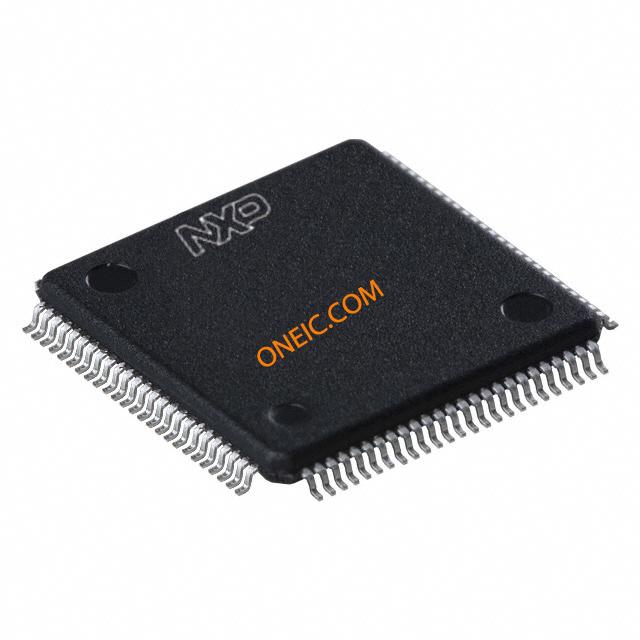
100-LQFP SOT407-1

100-LQFP
Image Preview