LPC2365FBD100
16/32-bit ARM7 microcontrollers with 256KB flash, 72MHz, 100-pin LQFP
Manufacturer: nxp
series introduction
# Introduction to the LPC2365FBD100 Product Series
## 1. Overview
The LPC2365FBD100 is a remarkable member of a product series that belongs to the ARM7 - based microcontroller family. These microcontrollers are designed to offer a high - performance, cost - effective, and feature - rich solution for a wide range of embedded applications. The "LPC2365" represents the specific model within the series, while "FBD100" indicates the package type and pin count, in this case, a 100 - pin Fine - Pitch Ball Grid Array (FBGA) package.
## 2. Key Features
### 2.1 Processor Core
- **ARM7TDMI - S Core**: At the heart of the LPC2365FBD100 lies the ARM7TDMI - S 32 - bit RISC processor core. This core provides a high - speed processing capability with a clock frequency that can reach up to 72 MHz. It offers a good balance between performance and power consumption, making it suitable for applications where both speed and energy efficiency are crucial.
- **Thumb Instruction Set**: The ARM7TDMI - S core supports the Thumb instruction set, which allows for more compact code storage. This is beneficial as it reduces the memory requirements of the application, enabling the use of smaller and more cost - effective memory devices.
### 2.2 Memory
- **On - Chip Flash Memory**: The LPC2365FBD100 is equipped with 512 KB of on - chip flash memory. This non - volatile memory is used to store the program code of the application. The large flash memory capacity allows for the implementation of complex algorithms and applications with extensive functionality.
- **On - Chip SRAM**: There is 40 KB of on - chip static random - access memory (SRAM). SRAM provides fast access to data, which is essential for the efficient execution of the program. It can be used to store variables, buffers, and intermediate results during the operation of the microcontroller.
### 2.3 Peripherals
#### 2.3.1 Communication Peripherals
- **UARTs (Universal Asynchronous Receiver - Transmitter)**: The device features multiple UARTs, typically 4 in the LPC2365FBD100. UARTs are widely used for serial communication with other devices such as sensors, displays, and other microcontrollers. They support various baud rates, allowing for flexible communication configurations.
- **SPI (Serial Peripheral Interface)**: An SPI interface is available, which provides a high - speed serial communication protocol. SPI is commonly used for communicating with external devices like flash memories, ADCs (Analog - to - Digital Converters), and DACs (Digital - to - Analog Converters). It offers a simple and efficient way to transfer data between the microcontroller and peripheral devices.
- **I²C (Inter - Integrated Circuit)**: The I²C interface enables communication with other I²C - compatible devices in a multi - master or multi - slave environment. It is often used for connecting sensors, EEPROMs, and other low - speed devices. The I²C interface in the LPC2365FBD100 supports standard, fast, and high - speed modes.
#### 2.3.2 Timers and Counters
- **Multiple Timers**: The microcontroller includes several timers, such as general - purpose timers and watchdog timers. General - purpose timers can be used for tasks like generating accurate time delays, measuring time intervals, and generating PWM (Pulse - Width Modulation) signals. Watchdog timers are used to monitor the operation of the
Images for reference
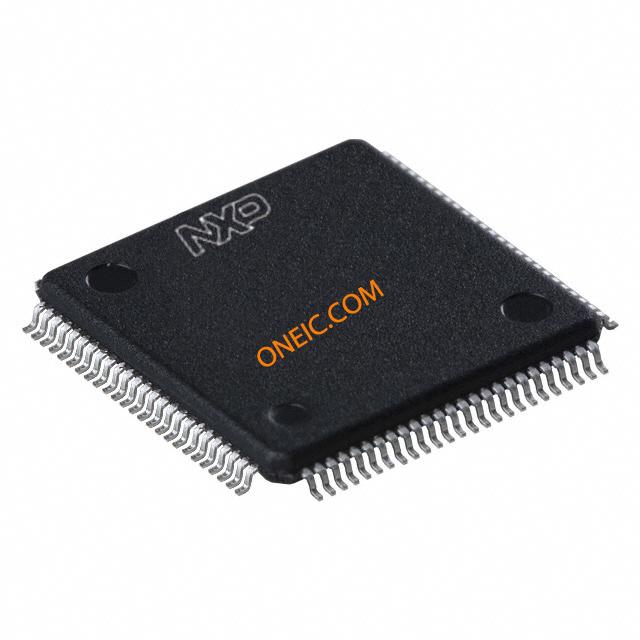
100-LQFP SOT407-1

100-LQFP

Image Preview