LPC2364HBD100
16/32-bit ARM7 microcontrollers with 128KB Flash, 100-pin LQFP
Manufacturer: nxp
series introduction
# Introduction to the LPC2364HBD100 Product Series
## 1. Overview
The LPC2364HBD100 is a highly versatile and powerful microcontroller product series that belongs to the ARM7 - based family of devices. These microcontrollers are designed to meet the diverse needs of modern embedded systems, offering a rich set of features and capabilities that make them suitable for a wide range of applications.
## 2. Key Features
### 2.1 Processor Core
- **ARM7TDMI - S Core**: The LPC2364HBD100 is built around the ARM7TDMI - S 32 - bit RISC processor core. This core provides high - performance processing capabilities with a clock speed of up to 100 MHz (as indicated by the “100” in the part number). It offers a high level of code density and efficient execution, making it ideal for applications that require real - time processing and complex algorithms.
- **Thumb Instruction Set**: In addition to the standard ARM instruction set, the core supports the Thumb instruction set. Thumb instructions are 16 - bit in length, which helps in reducing code size while maintaining good performance. This is particularly useful in applications with limited memory resources.
### 2.2 Memory
- **On - Chip Flash Memory**: The device comes with a large amount of on - chip flash memory. This non - volatile memory is used to store the program code of the embedded application. The flash memory provides fast access times, allowing for quick execution of the stored programs. It also supports in - system programming (ISP) and in - application programming (IAP), enabling easy software updates and customization.
- **On - Chip SRAM**: There is also a significant amount of on - chip static random - access memory (SRAM). SRAM is used for storing data during the execution of the program. It offers fast read and write access times, which is crucial for applications that require high - speed data processing and manipulation.
### 2.3 Peripherals
#### 2.3.1 Communication Peripherals
- **UART (Universal Asynchronous Receiver - Transmitter)**: Multiple UART interfaces are available, which are commonly used for serial communication with other devices such as sensors, displays, and communication modules. UARTs support a wide range of baud rates, making them compatible with various communication standards.
- **SPI (Serial Peripheral Interface)**: The SPI interface provides a high - speed serial communication protocol. It is often used for communicating with external devices such as flash memories, ADCs (Analog - to - Digital Converters), and DACs (Digital - to - Analog Converters). SPI allows for full - duplex communication and can achieve high data transfer rates.
- **I²C (Inter - Integrated Circuit)**: The I²C interface is a multi - master, multi - slave serial communication protocol. It is widely used for connecting low - speed devices such as sensors, EEPROMs, and real - time clocks. I²C simplifies the wiring and communication between multiple devices on a single bus.
#### 2.3.2 Timers and Counters
- **Multiple Timers**: The LPC2364HBD100 is equipped with several timers and counters. These can be used for a variety of purposes, such as generating accurate time delays, measuring time intervals, and generating PWM (Pulse - Width Modulation) signals. PWM signals are commonly used for motor control, LED dimming, and power management applications.
#### 2.3.3 Analog - to - Digital Converter (ADC)
- **Built - in ADC**: The device features an on - chip ADC. This ADC can be used to convert analog signals from sensors (such as
Images for reference
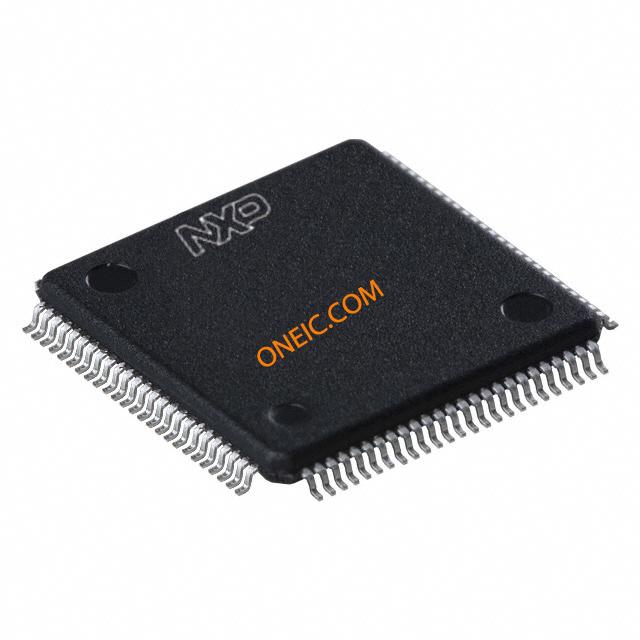
100-LQFP SOT407-1

100-LQFP
Image Preview