LPC2106FHN48
32-bit ARM7 microcontrollers with 128KB flash, 64KB RAM, 48-pin HVQFN
Manufacturer: nxp
series introduction
# Introduction to the LPC2106FHN48 Product Series
## 1. Overview
The LPC2106FHN48 is a remarkable member of a microcontroller product series developed by NXP Semiconductors. It belongs to the ARM7 - based LPC2100 family, which is well - known for its high - performance, low - power consumption, and rich peripheral integration. This specific model, the LPC2106FHN48, is designed to meet the diverse needs of embedded systems across a wide range of industries, from consumer electronics to industrial automation.
## 2. Key Features
### 2.1 Processor Core
- **ARM7TDMI - S Core**: At the heart of the LPC2106FHN48 lies the ARM7TDMI - S 32 - bit RISC processor core. This core offers a high - performance computing platform with a Harvard architecture, which separates the instruction and data buses, allowing for simultaneous access to instructions and data. It can operate at clock speeds up to 60 MHz, enabling fast execution of complex algorithms and real - time tasks.
- **Thumb Instruction Set**: The ARM7TDMI - S core supports the Thumb instruction set, which provides a more compact 16 - bit instruction format. This helps in reducing the code size, making it suitable for applications with limited memory resources.
### 2.2 Memory
- **On - Chip Flash Memory**: The LPC2106FHN48 is equipped with 128 KB of on - chip flash memory. This non - volatile memory is used to store the program code, allowing for easy reprogramming and firmware updates. The flash memory has a high - speed access time, which ensures fast execution of the stored code.
- **On - Chip SRAM**: There is 16 KB of on - chip static random - access memory (SRAM). The SRAM is used for storing data during program execution, such as variables, buffers, and stack space. Its fast access time enables efficient data processing.
### 2.3 Peripherals
#### 2.3.1 Serial Communication
- **UART (Universal Asynchronous Receiver - Transmitter)**: The LPC2106FHN48 features two UART interfaces. UARTs are commonly used for serial communication between the microcontroller and other devices, such as sensors, displays, or other microcontrollers. They support a wide range of baud rates, making them compatible with various communication standards.
- **SPI (Serial Peripheral Interface)**: One SPI interface is available, which provides a high - speed serial communication protocol. SPI is often used for communicating with external devices like flash memories, ADCs (Analog - to - Digital Converters), and DACs (Digital - to - Analog Converters). It allows for full - duplex communication and can achieve high data transfer rates.
- **I²C (Inter - Integrated Circuit)**: An I²C interface is included, which is a multi - master, multi - slave serial communication protocol. It is widely used for connecting low - speed devices, such as EEPROMs, sensors, and real - time clocks, in a simple and efficient way.
#### 2.3.2 Timer and Counter
- **Multiple Timers**: The microcontroller has multiple 32 - bit timers, which can be used for various purposes, such as generating time delays, measuring time intervals, and generating PWM (Pulse - Width Modulation) signals. PWM signals are commonly used for controlling the speed of motors, adjusting the brightness of LEDs, and other applications that require analog - like control.
#### 2.3.3 GPIO (General - Purpose Input/Output)
- **48 - Pin
Images for reference
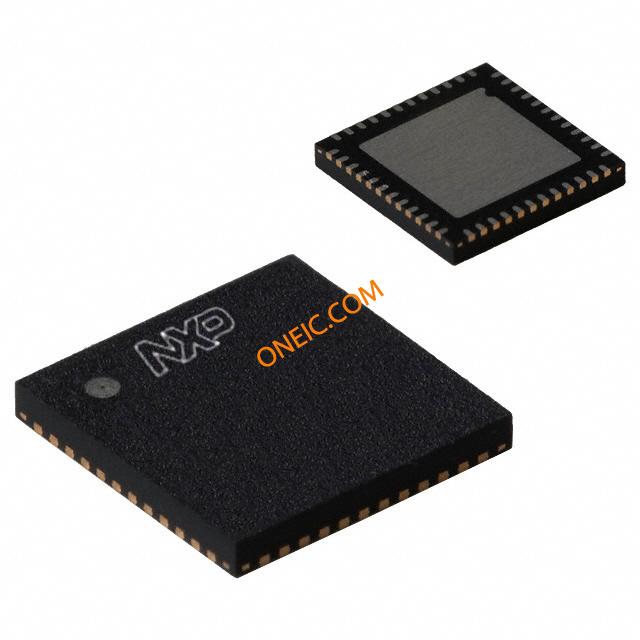
48-HVQFN,SOT619-1

Image Preview

Image Preview