EPM7032AETI44-7
Compact 3.3V CPLD devices with 32 macro cells for logic applications
Manufacturer: altera
series introduction
# Introduction to the EPM7032AETI44 - 7 Product Series
## 1. Overview
The EPM7032AETI44 - 7 belongs to the family of Complex Programmable Logic Devices (CPLDs). CPLDs are integrated circuits that offer a high - level of flexibility and functionality, making them suitable for a wide range of applications in the electronics industry. This particular product series is designed to provide reliable and efficient performance for various digital logic design requirements.
## 2. Key Features
### 2.1 Logic Capacity
The EPM7032AETI44 - 7 has a logic capacity of 32 macrocells. Macrocells are the basic building blocks of a CPLD, and they can be configured to implement a variety of logic functions such as combinational logic (e.g., AND, OR, NOT gates) and sequential logic (e.g., flip - flops). This capacity allows designers to create moderately complex digital circuits, including state machines, counters, and simple arithmetic units.
### 2.2 Package Type
It comes in a 44 - pin Thin Quad Flat Pack (TQFP) package, specifically the TQFP - 44. This package type offers several advantages. It has a relatively small footprint, which is beneficial for applications where space is limited, such as in portable devices. The TQFP package also provides good thermal performance, ensuring that the device can operate within its specified temperature range even under normal to moderate workloads.
### 2.3 Speed Grade
The “- 7” in the product name indicates the speed grade of the device. A lower speed grade number generally means a faster device. The EPM7032AETI44 - 7 is optimized for high - speed operation, with a propagation delay that allows for quick signal processing. This makes it suitable for applications that require real - time response, such as in communication systems where data needs to be processed and transmitted rapidly.
### 2.4 Programmability
One of the most significant features of the EPM7032AETI44 - 7 is its programmability. It can be programmed using industry - standard programming languages such as VHDL (Very High - Speed Integrated Circuit Hardware Description Language) or Verilog. Designers can use these languages to describe the desired logic functionality of the circuit, and then use a programming tool to configure the CPLD accordingly. This programmability allows for rapid prototyping and design changes, reducing the time and cost associated with developing new electronic products.
### 2.5 In - System Programmability (ISP)
The device supports In - System Programmability, which means that it can be programmed while it is installed on a printed circuit board (PCB). This feature is extremely useful for field upgrades and debugging. Designers can make changes to the device's configuration without having to remove it from the PCB, saving time and effort during the development and maintenance phases of a project.
## 3. Electrical Characteristics
### 3.1 Power Supply
The EPM7032AETI44 - 7 typically operates with a power supply voltage in the range of 4.75V to 5.25V. This standard power supply requirement makes it compatible with many existing electronic systems that use a 5V power source. The device also has relatively low power consumption, especially in standby mode, which is an important consideration for battery - powered applications.
### 3.2 Input/Output (I/O) Characteristics
It has a set of I/O pins that can be configured as either inputs or outputs. The I/O pins support a variety of logic levels, including TTL (Transistor - Transistor Logic) and CMOS (Complementary Metal - Oxide - Semiconductor
Images for reference

44-TQFP Pkg

44-TQFP
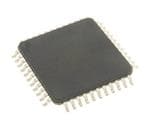
Image Preview