EPCS64
FPGA configuration memory ICs, 64Mb, 16-pin SOIC, 2.7-3.6V, 20-40MHz
Manufacturer: altera
series introduction
# EPCS64 Product Series Introduction
## 1. Overview
The EPCS64 product series is a cutting - edge family of programmable devices that play a crucial role in modern electronic systems. These devices are designed to provide reliable and efficient configuration solutions for a wide range of applications, from consumer electronics to industrial control systems.
## 2. Key Features
### 2.1 High - Density Storage
The EPCS64 devices offer a storage capacity of 64 Mbit. This high - density storage allows for the storage of large configuration data, enabling complex designs and the implementation of advanced features in target FPGAs (Field - Programmable Gate Arrays) or CPLDs (Complex Programmable Logic Devices). For example, in a high - performance video processing system, the large storage capacity can hold the detailed configuration required for real - time video encoding and decoding algorithms.
### 2.2 Fast Configuration Speed
With optimized internal architecture and advanced programming algorithms, the EPCS64 series provides fast configuration times. This is essential in applications where quick system startup is required, such as in automotive infotainment systems. The fast configuration speed ensures that the system can boot up rapidly and start functioning without significant delays, enhancing the overall user experience.
### 2.3 Low Power Consumption
In today's energy - conscious world, the EPCS64 series is designed with low power consumption in mind. The devices operate at low voltages and have power - saving modes, which are particularly beneficial for battery - powered devices like portable medical monitors. By consuming less power, the devices extend the battery life of the end - product, reducing the need for frequent battery replacements.
### 2.4 High Reliability
The EPCS64 devices are built to withstand harsh operating conditions. They have high resistance to temperature variations, electromagnetic interference (EMI), and mechanical stress. This makes them suitable for use in industrial environments, such as factory automation systems, where the devices may be exposed to extreme temperatures, vibrations, and electrical noise. The high reliability ensures stable operation over long periods, minimizing system downtime and maintenance costs.
### 2.5 Security Features
To protect sensitive configuration data, the EPCS64 series incorporates advanced security features. These include encryption algorithms and access control mechanisms. In applications such as military communication systems, where data security is of utmost importance, these security features prevent unauthorized access and ensure the integrity of the configuration data.
## 3. Technical Specifications
### 3.1 Memory Organization
The 64 Mbit memory of the EPCS64 is organized in a way that allows for efficient data storage and retrieval. It is divided into multiple sectors, which can be individually programmed and erased. This flexibility enables developers to update specific parts of the configuration data without affecting the entire memory, reducing programming time and complexity.
### 3.2 Interface
The EPCS64 devices support a standard Serial Peripheral Interface (SPI). This widely - used interface simplifies the connection between the EPCS64 and the target FPGA or CPLD. The SPI interface also allows for high - speed data transfer, ensuring that the configuration data can be quickly loaded into the target device.
### 3.3 Operating Temperature Range
The EPCS64 series can operate within a wide temperature range, typically from - 40°C to 85°C. This wide temperature range makes the devices suitable for use in various environments, from cold outdoor applications to high - temperature industrial settings.
### 3.4 Package Options
The EPCS64 devices are available in a variety of package options, including small - form - factor packages. This allows for easy integration into different printed circuit board (PCB) designs, whether it is a compact handheld device or a large industrial control panel.
## 4. Applications
### 4.1 FPGA/CPLD Configuration
The primary application
Images for reference

16 SOIC
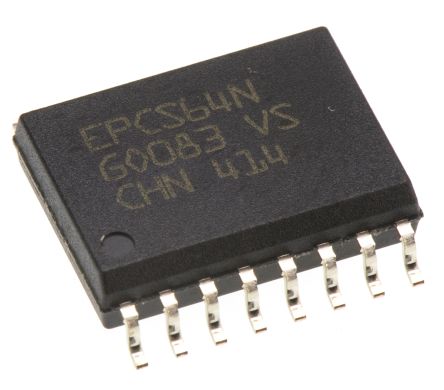
Image Preview

Image Preview