ATXMEGA16D4-AU
Versatile 8/16-bit microcontrollers with flash memory and TQFP packaging
Manufacturer: ['microchip', 'atmel']
series introduction
# Introduction to the ATXMEGA16D4 - AU Product Series
## 1. Overview
The ATXMEGA16D4 - AU is a member of the Atmel XMEGA D4 product family, which is part of Microchip Technology's extensive portfolio of microcontrollers. These microcontrollers are designed to offer high - performance, low - power operation, and a rich set of integrated peripherals, making them suitable for a wide range of applications.
## 2. Key Features
### 2.1. High - Performance CPU
- **AVR® XMEGA® CPU Core**: The ATXMEGA16D4 - AU is powered by an AVR XMEGA CPU core. This core features a Harvard architecture with a 32 - level pipeline, which enables high - speed instruction execution. It can operate at clock frequencies up to 32 MHz, providing fast processing capabilities for complex tasks.
- **Enhanced Instruction Set**: The instruction set of the AVR XMEGA core includes a wide range of arithmetic, logical, and control instructions. It also supports single - cycle multiplication and division operations, which significantly improves the performance of mathematical computations.
### 2.2. Memory
- **Flash Memory**: It comes with 16 KB of in - system self - programmable flash memory. This non - volatile memory is used to store the program code. The flash memory has a high endurance, allowing for frequent programming and erasing cycles, which is useful for applications that require software updates.
- **SRAM**: The microcontroller has 2 KB of static random - access memory (SRAM). SRAM is used for storing variables and data during program execution. The sufficient amount of SRAM enables the handling of complex algorithms and data processing tasks.
- **EEPROM**: There is also 512 bytes of electrically erasable programmable read - only memory (EEPROM). EEPROM is ideal for storing critical data such as calibration values, configuration settings, and user preferences that need to be retained even when the power is turned off.
### 2.3. Peripherals
#### 2.3.1. Analog Peripherals
- **Analog - to - Digital Converter (ADC)**: The ATXMEGA16D4 - AU is equipped with a 12 - bit ADC. It has multiple input channels, allowing for the conversion of analog signals from various sources. The ADC can operate at high speeds, enabling real - time data acquisition in applications such as sensor interfaces and measurement systems.
- **Digital - to - Analog Converter (DAC)**: A 10 - bit DAC is integrated into the microcontroller. The DAC can be used to generate analog output signals, which is useful for applications such as audio signal generation, motor control, and waveform synthesis.
#### 2.3.2. Communication Peripherals
- **Universal Synchronous and Asynchronous Receiver - Transmitter (USART)**: It has multiple USART interfaces, which support both synchronous and asynchronous communication modes. USARTs are commonly used for serial communication with other devices such as sensors, displays, and communication modules. They can operate at high baud rates, enabling fast data transfer.
- **Two - Wire Interface (TWI)**: The TWI interface is compatible with the I²C bus standard. It allows for easy communication with other I²C - compatible devices, such as EEPROMs, sensors, and other microcontrollers. The TWI interface supports both master and slave modes, providing flexibility in system design.
- **Serial Peripheral Interface (SPI)**: The SPI interface is a high - speed serial communication interface. It is used for communicating with external devices such as flash memories, sensors, and display controllers. The SPI interface supports full - duplex communication, allowing for simultaneous data transmission and
Images for reference

44-TQFP

Image Preview
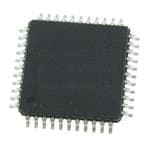
Image Preview