ATMEGA644PV-10PU
8-bit AVR microcontrollers with 64KB Flash, versatile voltage support
Manufacturer: ['microchip', 'atmel']
series introduction
# Introduction to the ATMEGA644PV - 10PU Product Series
## 1. Overview
The ATMEGA644PV - 10PU is a member of the highly regarded AVR microcontroller family developed by Microchip Technology. This product series is designed to offer a powerful, flexible, and cost - effective solution for a wide range of embedded system applications. With its rich set of features and capabilities, it has become a popular choice among engineers and hobbyists alike.
## 2. Key Features
### 2.1 Microcontroller Core
- **AVR Architecture**: Based on the advanced AVR RISC (Reduced Instruction Set Computing) architecture, the ATMEGA644PV - 10PU provides high - performance processing. It can execute most instructions in a single clock cycle, enabling efficient code execution and fast response times.
- **16 - bit Instruction Set**: The 16 - bit instruction set allows for a wide range of operations, including arithmetic, logical, and data transfer operations. This provides developers with the flexibility to implement complex algorithms and functions.
### 2.2 Memory
- **Flash Memory**: It comes with 64KB of in - system self - programmable Flash memory. This non - volatile memory is used to store the program code, allowing for easy updates and reprogramming of the microcontroller. The large Flash memory capacity enables the implementation of relatively large and complex applications.
- **SRAM**: There is 4KB of internal Static Random - Access Memory (SRAM). SRAM is used for storing variables and data during program execution. The sufficient SRAM size ensures smooth operation of applications that require data buffering and manipulation.
- **EEPROM**: The microcontroller also features 2KB of Electrically Erasable Programmable Read - Only Memory (EEPROM). EEPROM is useful for storing non - volatile data such as calibration values, configuration settings, and user - specific data that need to be retained even when the power is turned off.
### 2.3 Peripherals
#### 2.3.1 General - Purpose Input/Output (GPIO)
- The ATMEGA644PV - 10PU has a total of 32 general - purpose I/O pins. These pins can be configured as either input or output, allowing for easy interfacing with external devices such as sensors, actuators, and displays. The GPIO pins support various input and output modes, including pull - up and pull - down resistors, which enhance the flexibility of the microcontroller in different applications.
#### 2.3.2 Timers/Counters
- **Three 16 - bit Timers/Counters**: These timers can be used for a variety of purposes, such as generating accurate time delays, measuring time intervals, and generating Pulse Width Modulation (PWM) signals. PWM signals are commonly used in motor control, LED dimming, and power management applications.
- **One 8 - bit Timer/Counter**: The 8 - bit timer provides additional timing capabilities and can be used for less demanding timing tasks, reducing the load on the 16 - bit timers.
#### 2.3.3 Serial Communication Interfaces
- **Universal Synchronous/Asynchronous Receiver/Transmitter (USART)**: The USART allows for full - duplex serial communication, enabling the microcontroller to communicate with other devices such as computers, sensors, and communication modules. It supports various baud rates and data formats, making it compatible with a wide range of serial devices.
- **Two - Wire Serial Interface (TWI)**: Also known as the I2C interface, the TWI provides a simple and efficient way to communicate with other I2C - compatible devices. It is commonly used for connecting sensors, EEPROMs, and other
Images for reference
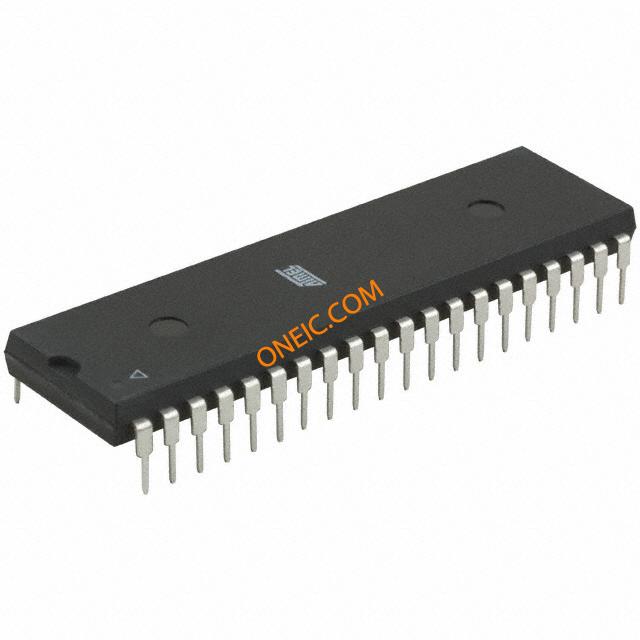
40-DIP Pkg
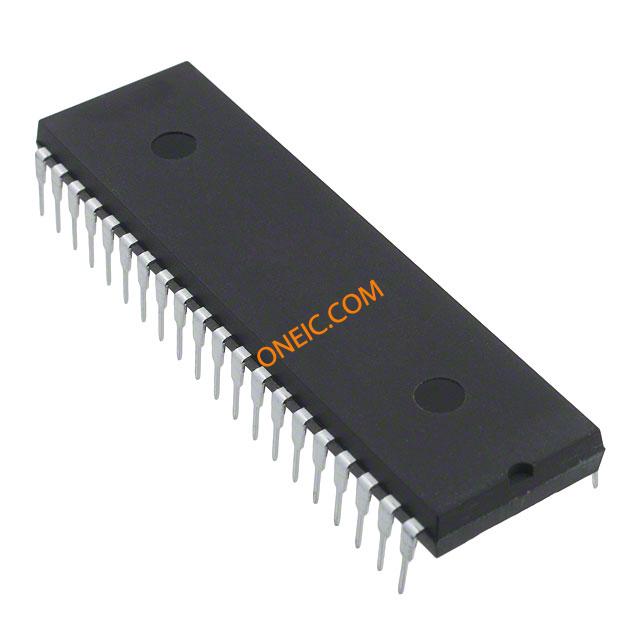
40-DIP

Image Preview