ATMEGA3290P-20AU
8-bit AVR microcontrollers with 32KB flash, 2KB RAM, and TQFP packaging
Manufacturer: ['microchip', 'atmel']
series introduction
# ATMEGA3290P - 20AU Product Series Introduction
## 1. Overview
The ATMEGA3290P - 20AU is a member of the highly regarded AVR® 8 - bit microcontroller family developed by Microchip Technology. This product series is designed to offer a powerful, flexible, and cost - effective solution for a wide range of embedded applications. With its rich set of features and high - performance capabilities, it has become a popular choice among engineers and hobbyists alike.
## 2. Key Features
### 2.1 Microcontroller Core
- **AVR Architecture**: Based on the advanced AVR RISC architecture, the ATMEGA3290P - 20AU provides a high - level of code efficiency. It can execute most instructions in a single clock cycle, enabling fast processing speeds and efficient use of system resources.
- **20 MHz Clock Speed**: The microcontroller operates at a maximum clock frequency of 20 MHz, allowing for rapid data processing and real - time response in time - critical applications.
### 2.2 Memory
- **32 KB Flash Memory**: It comes with 32 KB of in - system self - programmable Flash memory, which is used to store the program code. This large memory capacity allows for the implementation of complex applications with extensive functionality.
- **2 KB SRAM**: The 2 KB of static random - access memory (SRAM) provides sufficient space for data storage during program execution. It can be used to store variables, buffers, and intermediate results, facilitating efficient data handling.
- **1 KB EEPROM**: The electrically erasable programmable read - only memory (EEPROM) is non - volatile, meaning it retains data even when the power is turned off. It is ideal for storing configuration data, calibration values, and other important information that needs to be preserved across power cycles.
### 2.3 Peripherals
#### 2.3.1 General - Purpose Input/Output (GPIO)
- The ATMEGA3290P - 20AU features a generous number of GPIO pins. These pins can be configured as either input or output, allowing for easy interfacing with external devices such as sensors, actuators, and displays. The GPIO pins also support various modes, including pull - up and pull - down resistors, enhancing their flexibility in different application scenarios.
#### 2.3.2 Timer/Counters
- It is equipped with multiple timer/counters, including 8 - bit and 16 - bit timers. These timers can be used for a variety of purposes, such as generating accurate time delays, measuring time intervals, and generating pulse - width modulation (PWM) signals. PWM signals are commonly used for controlling the speed of motors, adjusting the brightness of LEDs, and other applications that require precise control of analog signals.
#### 2.3.3 Serial Communication Interfaces
- **USART (Universal Synchronous/Asynchronous Receiver/Transmitter)**: The USART interface enables serial communication with other devices, such as computers, sensors, and communication modules. It supports both synchronous and asynchronous communication modes, allowing for flexible data transfer at different baud rates.
- **SPI (Serial Peripheral Interface)**: The SPI interface provides a high - speed serial communication protocol for communicating with external devices. It is commonly used for interfacing with flash memories, sensors, and other peripherals that require fast data transfer.
- **TWI (Two - Wire Interface)**: Also known as the I2C interface, the TWI allows for easy communication with other I2C - compatible devices. It is a widely used protocol for connecting multiple devices on a single bus, reducing the number of wires required for communication.
#### 2.3.4 Analog - to -
Images for reference
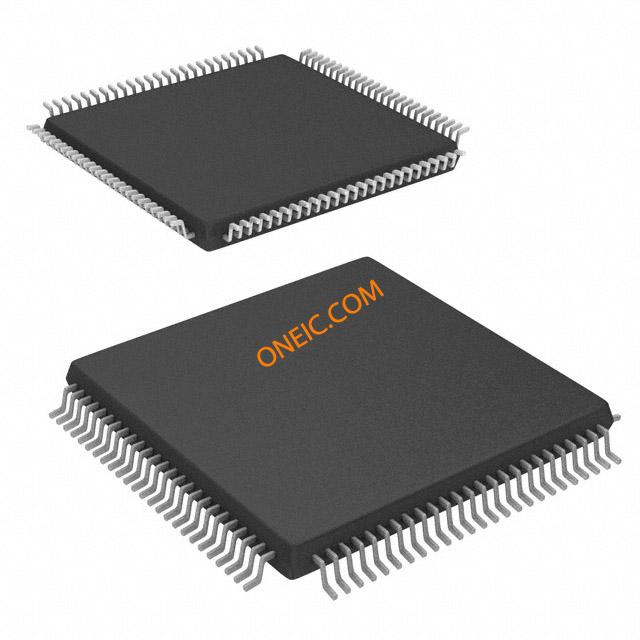
100TQFP

100-TQFP Pkg

128-TQFP