ATMEGA16L-8AU
8-bit AVR microcontrollers with 16KB Flash, 44-pin TQFP package
Manufacturer: ['microchip', 'atmel']
series introduction
# Introduction to the ATMEGA16L - 8AU Product Series
## 1. Overview
The ATMEGA16L - 8AU is a member of the popular AVR microcontroller family developed by Microchip Technology (formerly Atmel). This product series is well - known for its high performance, low power consumption, and rich set of integrated peripherals, making it suitable for a wide range of embedded applications.
## 2. Key Features
### 2.1 Microcontroller Core
- **AVR RISC Architecture**: The ATMEGA16L - 8AU is based on the Advanced Virtual RISC (AVR) architecture. This Reduced Instruction Set Computing (RISC) design allows for efficient execution of instructions, with most instructions being executed in a single clock cycle. This results in high processing speeds and better overall performance compared to traditional CISC architectures.
- **8 - bit CPU**: It features an 8 - bit central processing unit, which is ideal for applications that do not require extremely high - end processing power but need a cost - effective and reliable solution. The 8 - bit data path simplifies the design of the microcontroller and makes it easier to interface with other 8 - bit components commonly used in embedded systems.
### 2.2 Memory
- **Flash Program Memory**: The microcontroller comes with 16KB of in - system self - programmable Flash memory. This non - volatile memory is used to store the program code of the application. The in - system self - programming feature allows for easy firmware updates, enabling developers to modify and improve the functionality of the device without having to remove it from the circuit board.
- **SRAM**: There is 1KB of Static Random - Access Memory (SRAM) available for data storage during program execution. SRAM provides fast access to data, which is crucial for efficient program operation, especially when dealing with variables, buffers, and temporary data.
- **EEPROM**: A 512 - byte Electrically Erasable Programmable Read - Only Memory (EEPROM) is also included. EEPROM is used to store non - volatile data that needs to be retained even when the power is turned off, such as configuration settings, calibration data, or user - specific information.
### 2.3 Low Power Consumption
- **Power - Saving Modes**: The ATMEGA16L - 8AU offers multiple power - saving modes, including idle mode, ADC noise reduction mode, power - down mode, power - save mode, standby mode, and extended standby mode. In power - down mode, the microcontroller consumes extremely low power, making it suitable for battery - powered applications where energy efficiency is a critical factor.
- **Low - Voltage Operation**: It can operate at a wide range of supply voltages, typically from 2.7V to 5.5V. This low - voltage operation not only reduces power consumption but also allows for compatibility with a variety of power sources, including batteries and low - voltage power supplies.
### 2.4 Peripherals
#### 2.4.1 Timers/Counters
- **Three Timers/Counters**: The microcontroller is equipped with three timers/counters: Timer/Counter0, Timer/Counter1, and Timer/Counter2. These timers can be used for a variety of applications, such as generating accurate time delays, measuring time intervals, generating PWM (Pulse Width Modulation) signals for motor control or LED dimming, and implementing real - time clock functions.
- **PWM Modes**: All three timers support different PWM modes, allowing for precise control of the duty cycle and frequency of the output signals. This is particularly useful in applications where analog - like control is required, such as controlling the speed of a DC motor or the brightness of an LED.
####
Images for reference

44-TQFP

Image Preview
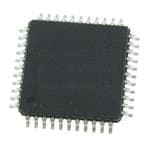
Image Preview